Friday, May 8, 2009
Song of Ice and Fire
Upon reflecting the end of yet another semester, I was talking with one of my friends about my 21st century fantasy seminar and this reminded him to inform me of some good news. Apparently HBO has recently ordered a new series that will be adapted from A Song of Ice and Fire, the first of the series being A Game of Thrones. Casting is now in order. Who else is excited?


Friday, May 1, 2009
Precursor to The Village
The young-adult novel mentioned in class that shares plot elements with M. Night Shyamalan's 2004 movie The Village is Running Out of Time by Margaret Peterson Haddix, published in 1995.
Moorcock on Tolkien, Lewis and company
"Epic Pooh," an infamous anti-J.R.R. Tolkien, anti-C.S. Lewis screed by the great British fantasist Michael Moorcock, written in 1978, can be found in its entirety here, at Revolution SF. An excerpt:
I sometimes think that as Britain declines, dreaming of a sweeter past, entertaining few hopes for a finer future, her middle-classes turn increasingly to the fantasy of rural life and talking animals, the safety of the woods that are the pattern of the paper on the nursery room wall. Old hippies, housewives, civil servants, share in this wistful trance; eating nothing as dangerous or exotic as the lotus, but chewing instead on a form of mildly anaesthetic British cabbage. If the bulk of American sf could be said to be written by robots, about robots, for robots, then the bulk of English fantasy seems to be written by rabbits, about rabbits and for rabbits.
Thursday, April 30, 2009
Enchanted Music
I might be alone, but I hated the music in Enchanted. No particular reason that I can point to, I just didn't like it. To my ears, it never really lived up to the Disney classics, such as:
Feel free to disagree or one-up me with other Disney songs.
And as a supplement to the excellent CD Andy made for us, I would suggest the following tracks for this semester:
Coldplay - Cemeteries of London (England, graveyard, ghosts, witches... perfect Graveyard Book song)
Murder by Death - Comin' Home (Werewolf overtones, a la Kelly Link)
Mew - She Came Home for Christmas (Creepy child abuse theme, harped by Joe Hill)
Symphony X - Awakenings (Wishing well, shown in Enchanted)
Porcupine Tree - Lazarus (Ghosts... kinda)
Goo Goo Dolls - Iris (Works for that short story with angels)
Nightwish - Beauty of the Beast (Gothic vampire theme)
Feel free to disagree or one-up me with other Disney songs.
And as a supplement to the excellent CD Andy made for us, I would suggest the following tracks for this semester:
Coldplay - Cemeteries of London (England, graveyard, ghosts, witches... perfect Graveyard Book song)
Murder by Death - Comin' Home (Werewolf overtones, a la Kelly Link)
Mew - She Came Home for Christmas (Creepy child abuse theme, harped by Joe Hill)
Symphony X - Awakenings (Wishing well, shown in Enchanted)
Porcupine Tree - Lazarus (Ghosts... kinda)
Goo Goo Dolls - Iris (Works for that short story with angels)
Nightwish - Beauty of the Beast (Gothic vampire theme)
Wednesday, April 29, 2009
Enchanted References
On Wikipedia I found a page that mention the references to Disney films in Enchanted. I know Wikipedia not the most reliable but I though it would be interesting to post.
http://en.wikipedia.org/wiki/List_of_Disney_references_in_Enchanted
http://en.wikipedia.org/wiki/List_of_Disney_references_in_Enchanted
Sex, Potions, and Rock n' Roll?
In a recent article I stumbled upon in anticipation for the next movie installment of Harry Potter, Director David Yates speaks on his take of the film and what he tried to really showcase.
He claims this film is much more sexualized than the previous one (where our biggest romantic moment came with a sickeningly awkward kiss....) and that although sex itself isn't shown (thank god...talk about unsettling), we will apparently be able to tell its there.
Ok, granted I get that the characters are getting older, and we can't have them just eat chocolate frogs and sharing hugs forever, but i never got the impression that the sixth book was in anyway classified in the "sexual explosion" category. Yes, they were clearly in their teenage prime at 16 in this installment, but i would never say i felt it was ever "quite naughty".
I call shenanigans.
I am obviously aware of the whole "treat movies as separate entities of their novel counterparts" idea. I agree with this, and I have always been generally annoyed with those that seek to pick apart miniscule details of the movies that don't agree with the books...but I feel this is a little bit bigger than that. It's like presenting a whole different feel and atmosphere to the story, when in fact, while a little of this sexy spunk is needed to show maturity, it should not be an overriding and overbearing movie.
Is this just me? Did I misinterpret HPHBP in this regard; did i miss this apparently obvious sexual definition? Or is this just Yates and WB working together to increase the moo-la flow at the end of it all? Afterall, sex does pay. And its not like there are millions of girls out there that would only be too eager to dish out their bucks to see Dan or Rupert turnin' it on...
I would like to hope the later....the easier answer to accept
Monday, April 27, 2009
Last class we talked briefly about how specific scenes in Enchanted mimicked specific scenes in other classic disney movies. For some screen captures that illustrate this checkout this link: click me.
* Sarah if you haven't already found these they might be helpful. :)
"Secondary" Escapism
I feel like I was a but tongue-tied in my paper presentation last week, and now that I am actually writing this paper I have gained a little clarity. I am breaking up Hill's escapism into three categories. The first being the most common escapism where the reader delves into a world where the impossible is possible. Like The Graveyard Book or Harry Potter. Some of Hill's stories are like this, and this is what I'm thinking of as "Primary" Escapism. The second kind I have dubbed "Secondary" Escapism. I think of this as when something paranormal happens to the characters, and they recognize it as paranormal. It is beyond the parameters of the world they know which is the same world we know, so the characters escape rather than the readers. The third would be a literal escape which Hill uses very frequently as well as "Secondary" escapes. Okay maybe this is a but clearer now. Even to me.
Saturday, April 25, 2009
Masking the truth or Masking something else.....
As I mentioned in class, I've decided to write my next paper on the topic of Masks. More specifically, how the idea of masks are used in Joe Hill's short story "My Father's Mask." To begin, I read through the story paying special attention to details and recorded every instance when a new mask was mentioned/introduced. I want to focus on exploring the background of those masks that were specifically mentioned and make any connections I can to the storyline itself. Here's my list as of late:
"One had whiskers and glittery spackle on it and would make the wearer look like a jeweled mouse" (246).
"..rich black velvet...for a courtesan on her way to an Edwardian masquerade" (246).
"...crimson mask...with a hooked beak and feathers around the eyes--just the thing to wear if you had been cast as the Red Death in an Edgar Allen Poe revival" (246).
"...distorted by clear plastic, and looked like a man's face molded out of an impossibly thin piece of ice"(246).
"half-face mask...made of green silk leaves, sewn together and ornamented with emerald sequins"(248).
"black kitten mask, edged in rhinestones, and with glistening whiskers..."(249).
"Very Dionysian. Very Pan" (251) [description for the mask made of green silk leaves]
"black sequined mask, with a fan of strich feathers standing up from one side" (255).
"smooth plastic mask the color of milk" (255).
Here were some of the observations I made about this list:
As far as masks, there were references to masquerade ball, Edgar Allen Poe's "The Masque of the Red Death," Greek mythology gods, and other animal references.
"One had whiskers and glittery spackle on it and would make the wearer look like a jeweled mouse" (246).
"..rich black velvet...for a courtesan on her way to an Edwardian masquerade" (246).
"...crimson mask...with a hooked beak and feathers around the eyes--just the thing to wear if you had been cast as the Red Death in an Edgar Allen Poe revival" (246).
"...distorted by clear plastic, and looked like a man's face molded out of an impossibly thin piece of ice"(246).
"half-face mask...made of green silk leaves, sewn together and ornamented with emerald sequins"(248).
"black kitten mask, edged in rhinestones, and with glistening whiskers..."(249).
"Very Dionysian. Very Pan" (251) [description for the mask made of green silk leaves]
"black sequined mask, with a fan of strich feathers standing up from one side" (255).
"smooth plastic mask the color of milk" (255).
Here were some of the observations I made about this list:
As far as masks, there were references to masquerade ball, Edgar Allen Poe's "The Masque of the Red Death," Greek mythology gods, and other animal references.
Wednesday, April 22, 2009
Paper Topic-Monsters
For my paper topic I think I am going back on a blog post I made awhile back called "Fake Monsters." I would like to talk about the different types of monsters we have read about. How some our explainable, and some not and why.
You Will Hear The Locust Sing
Ok this was my story last week. So here are my thoughts. It really wasn't a horror story. I wasn't scared at all. It is basically the story of a boy who turns into an insect (locust). While the story wasn't scary it was very crude and grotesque. The most interesting part of the whole story was how the title was woven into the story. Especially the ending, when the boy (Francis) begings to sing.
Again I'll repeat that the artwork that originally accompanied this story is available in one of my earlier posts.
Again I'll repeat that the artwork that originally accompanied this story is available in one of my earlier posts.
Monday, April 20, 2009
Paper Topic
I was also thinking of doing a paper on Enchanted. Instead of focusing on the other Disney classics incorporated into the movie like Sara is planning on, I want to focus on the tension between fantasy and reality in the film.
I think that this is the main focus of the story. My paper would explore how it contradicts "real fairy tales", but is in fact a fairy tale itself. My attempt is to also answer how this film relates to children growing up, out of "make-believe" and into "reality." And finally the use of animation and live filming to accomplish this goal.
*Sara if this is too much like what you were thinking, let me know and I'll change. :)
I think that this is the main focus of the story. My paper would explore how it contradicts "real fairy tales", but is in fact a fairy tale itself. My attempt is to also answer how this film relates to children growing up, out of "make-believe" and into "reality." And finally the use of animation and live filming to accomplish this goal.
*Sara if this is too much like what you were thinking, let me know and I'll change. :)
Potential Paper Topic.....Part II?
No, it's not the same Sara(h), but I would also like to run my topic by everyone for feedback before I delve further into my research. I personally think I am at the edge of a good paper, but can't really find my footing. If it seems totally bogus, let me know.
I would like to talk about what the authors that we have read (such as Kelly Link, Joe Hill) have done as far as effectively creating an homage to others' works without ripping it off....essentially, my paper becomes "Remembrances vs. Rip-Offs". It would explain what differentiates the two. Imagine Kelly Link's multitude of stories that brought so many other fantasy stories, movies and media to mind; her writing is so effective at jarring our memories of these things, but I would hardly consider any of her works a rip-off of anything else. It interests me how I can read something and smile at the familiarity and yet other times I read a story and am disgusted with lack of originality and the borrowing of others' ideas. I want to focus on the "secrets of their successes" in accomplishing the former.
Does this make any sense? Haha, I think it's either really far-fetched or just too downright philosophical. I have back-up ideas just in case, but this one sticks out the most. Suggestions?
I would like to talk about what the authors that we have read (such as Kelly Link, Joe Hill) have done as far as effectively creating an homage to others' works without ripping it off....essentially, my paper becomes "Remembrances vs. Rip-Offs". It would explain what differentiates the two. Imagine Kelly Link's multitude of stories that brought so many other fantasy stories, movies and media to mind; her writing is so effective at jarring our memories of these things, but I would hardly consider any of her works a rip-off of anything else. It interests me how I can read something and smile at the familiarity and yet other times I read a story and am disgusted with lack of originality and the borrowing of others' ideas. I want to focus on the "secrets of their successes" in accomplishing the former.
Does this make any sense? Haha, I think it's either really far-fetched or just too downright philosophical. I have back-up ideas just in case, but this one sticks out the most. Suggestions?
Potential Paper topic
Ok, so in an attempt to have a better idea of what I want to write about this time around, I thought I would run my idea by y'all before class Wednesday.
I know that I want to write about, Enchanted, and I was thinking I could explore all of the different fairy tales that are incorporated into the story. Most of the story is hinged on elements of classic Disney movies, as well as basic fairy tale stereotypes.
I will expand on this in class, but I was just going to try to get an idea of what you guys thought.
Wednesday, April 15, 2009
"In the Rundown"
The "Rundown" is the baseball scenario when a runner is trapped between bases, both ways ending in being tagged out. Wyatt experiences this situation as a little leaguer and again in the climax when he must find help for Baxter who has been stabbed. I wasn't sure how I felt about this metaphor. In the baseball rundown, both ways end in defeat. In the rundown he faces presently, on the one end you have the dying boy, but the threat had been removed as the mother flees the area. On the other end you have safety once he flags down the police car. Although we aren't told if Baxter survives or not, it can be assumed that he received help. The metaphor is really only useful to me in that one end of both rundowns is to Treat Rendell, at second base and then as a state trooper.
This story I found to be a little different from the others in terms of the protagonist. Many of Hill's protagonists are younger boys growing up or men reflecting back on their childhood. This protagonist does flashback to his childhood, but this story is not nearly as focused on his development like several other of his stories are. He is the same age throughout the story, and he is an older guy than many of the others. Also, this story takes place in one afternoon, while several others span weeks or months and even a lifetime in "20th Century Ghost"'s case.
Another thing I would like to point out is Hill's use of distinctly American images that recur through his stories. The obvious one in this story being baseball. It is also mentioned in at least two other stories. Also, the image of a hardware store is pretty American and is seen in this story and a couple others.
This story was definitely one of the scarier ones, but overall relatively enjoyable. Not my favorite though.
This story I found to be a little different from the others in terms of the protagonist. Many of Hill's protagonists are younger boys growing up or men reflecting back on their childhood. This protagonist does flashback to his childhood, but this story is not nearly as focused on his development like several other of his stories are. He is the same age throughout the story, and he is an older guy than many of the others. Also, this story takes place in one afternoon, while several others span weeks or months and even a lifetime in "20th Century Ghost"'s case.
Another thing I would like to point out is Hill's use of distinctly American images that recur through his stories. The obvious one in this story being baseball. It is also mentioned in at least two other stories. Also, the image of a hardware store is pretty American and is seen in this story and a couple others.
This story was definitely one of the scarier ones, but overall relatively enjoyable. Not my favorite though.
If only Buffy had this upbrining...
I've always been ambivalent on modern 'reimaginings' - they have a history of being polarizing in the 'quality' debate. Thus, I think my general unfamiliarity with the Dracula/Van Hellsing mythos definitely worked in my favor. Without any previous cultural baggage, I found myself really enjoying "Abraham's Boys" as a look at how children deal with moral decisions.
I'm inherently attracted to "with great power" stories, wherein children deal with being given 'adult' powers (thus my love of the Shazam!/Captain Marvel mythos), and I can understand Max's choice to use his "powers" (in this case, the knowledge of how to kill someone) for what he views as the greater good. Hill clearly leaves the question of 'what is the greater monster, the vampires or the tyrannical fanaticism of Abraham?' up to readers; his choice in perspective, however, clearly nudges readers in one direction.
I'm inherently attracted to "with great power" stories, wherein children deal with being given 'adult' powers (thus my love of the Shazam!/Captain Marvel mythos), and I can understand Max's choice to use his "powers" (in this case, the knowledge of how to kill someone) for what he views as the greater good. Hill clearly leaves the question of 'what is the greater monster, the vampires or the tyrannical fanaticism of Abraham?' up to readers; his choice in perspective, however, clearly nudges readers in one direction.
You Will Hear The Locust Sing

This is a piece of digital art by Vincent Chong that appeared with the first publication of Hill's story "You will hear the locust sing." Vincent has contributed to the cover design of both 20th Century Ghost and Heart-Shaped Box.
"Joe Hill is One Stealthy Bastard"
...Chirstopher Golden couldn't have said it better in his introduction to 20th Century Ghosts.
Joe Hill certainly is an entertaining read, his book was definitely a good one to end the semester on, in terms of reading that is.
Of course, I had to look up his website, it's what I do. In terms of overall enjoyableness and readability, I would place his personal blog right up there with Neil Gaiman. Actually, I might even give Hill first place. His archives go all the way back to July 2005, talk about blog dedication...
I particularly liked a key design contest he apparently had on his site, open for fans to design their version of the Ghost Key. Other cool aspects of his site--he'll share with you daydreams he had as a kid, he encourages helping out independent book stores by throwing other contests, and while not all of his posts pertain to his works, you can still learn a little more about each one.
I particularly liked his blog on his failed attempt to write a Spider Man story...
Check out his website here
And for those of you on Twitter, Hill is up on that recent trend too: Twitter!
Last Breath
So I guess I'll start with my discussion on here. I didn't realize that this story was this short...I wasn't trying to pick the shorter one. But anyway, I really disliked this story. The whole plot was just weird and at the end when the woman died, I really wanted to know what she heard from the Carrie Mayfield jar that made her act so disoriented. Did anyone else feel this way? I just felt like explaining what she heard would have given more insight and more understanding for the story. Overall, just wasn't my favorite.
20th Century Ghosts
So, I don't know if anyone else has been disappointed with this book, but I was really expecting something different. To me, I thought with the title, it would be scary ghost stories; instead a lot of them didn't scare me at all. Like Pop Art, unless I was missing something, an inflatable person is not scary, just really strange. And the story I had to read, Last Breath, wasn't very exhilarating either. I don't know. I really loved Best New Horror, it was probably my favorite, just because it was scariest. I think the title of the book should have been different. But, I guess my say so really doesn't matter..haha.
Monday, April 13, 2009
Salad Fingers
For some reason, certain parts of this collection remind me of the famous e-cartoon series Salad Fingers. It was fairly popular a few years back, and definitely has an atmosphere of psychological horror that matches well with, say, "Best New Horror." Pretty surreal stuff; I'm a fan.
Just remember to turn off the lights and up the volume when you watch them. Clicky my linky.

Just remember to turn off the lights and up the volume when you watch them. Clicky my linky.
Sunday, April 12, 2009
Fantasia and 20th Century Ghost
So, I hope I'm not completely wrong on this, but I'm pretty sure the movie playing when Alec meets Imogene in the theatre is Fantasia - the 1940 Disney movie.
If I am correct, then the comments about how it is not a children's movie is definitely true. My experiences with Fantasia go back to when I was really young, like preschool age, and my grandmother would show me Fantasia ALL THE TIME. And I hated it. It terrified me. Seriously. The music and the animation...definitely too much for my very young brain. Probably scarred me for life.
I suppose I should go back and watch the movie, now that I would probably have some appreciation for it. But with my current memories, it is totally the appropriate movie to be playing for such a creepy encounter. Reservoir Dogs is mentioned as well, as a movie when a patron comes in contact with Imogene - also appropriate.
So, any thoughts?
If I am correct, then the comments about how it is not a children's movie is definitely true. My experiences with Fantasia go back to when I was really young, like preschool age, and my grandmother would show me Fantasia ALL THE TIME. And I hated it. It terrified me. Seriously. The music and the animation...definitely too much for my very young brain. Probably scarred me for life.
I suppose I should go back and watch the movie, now that I would probably have some appreciation for it. But with my current memories, it is totally the appropriate movie to be playing for such a creepy encounter. Reservoir Dogs is mentioned as well, as a movie when a patron comes in contact with Imogene - also appropriate.
So, any thoughts?
Widow's Breakfast
I don't know if anyone noticed this or if it is worth mentioning. One of the boys in Widow's Breakfast is named Gage. I was trying to think if a knew someone named Gage, it was so familiar. Then I realized that that was the name of the little boy in Pet Sematary. Just thought that might be worth mentioning.
Friday, April 10, 2009
Best New Horror
Ok, so I read the first story in the book expecting to pee my pants after what Andy said about it being terrifying, but I actually really liked it!
Did anyone think of Neil Gaiman's Coraline when reading the summary of Peter Kilrue's story? I had a flashback as soon as I saw the word "Buttonboy" and then learned that he had pins over his eyes.
Also....Texas Chainsaw Massacre, anyone? Haha, as soon as Carroll pulled up the driveway at the Kilrue place, I had another moment. The whole Texas Chainsaw/Devil's Rejects vibe came over me.
I can't help but wonder if Hill did this on purpose, though? This book was published in 2005, after Coraline (2002) and LONG after the original TCM. I think that he pulled a Kelly Link, purposely wanting us to be reminded of these horror stories while we were reading, just as the narrator seems to read the same stories over and over as an editor.
I really enjoyed this story. Anyone agree?
Did anyone think of Neil Gaiman's Coraline when reading the summary of Peter Kilrue's story? I had a flashback as soon as I saw the word "Buttonboy" and then learned that he had pins over his eyes.
Also....Texas Chainsaw Massacre, anyone? Haha, as soon as Carroll pulled up the driveway at the Kilrue place, I had another moment. The whole Texas Chainsaw/Devil's Rejects vibe came over me.
I can't help but wonder if Hill did this on purpose, though? This book was published in 2005, after Coraline (2002) and LONG after the original TCM. I think that he pulled a Kelly Link, purposely wanting us to be reminded of these horror stories while we were reading, just as the narrator seems to read the same stories over and over as an editor.
I really enjoyed this story. Anyone agree?
Joe Hill story assignments
For our April 15 class, here's the lineup of the people who are starting the 20th Century Ghosts conversations, story by story, as decided this past Wednesday. (Zach and Joe got assigned theirs in absentia.)
Wasn't it considerate of Hill to include the same number of stories as we have students in the class?
Keep in mind that story summaries are unnecessary unless you feel a need to sort out a confusing plotline; keep in mind, too. That you can start the conversation here on the blog, even before class.
"Best New Horror": Dan Roberts
"20th Century Ghosts": Kayla Lisenby
"Pop Art": Adam Cohen
"You Will Hear the Locust Sing": Kellie Hensley
"Abraham's Boys": Avery Dame
"Better than Home": Sara Chesler
"The Black Phone": Katie Whatley
"In the Rundown": Lauren Tucker
"The Cape": Natalie Beck
"Last Breath": Katie Huffaker
"Dead-Wood": Zach Narvaez
"The Widow's Breakfast": Jennifer Chen
"Bobby Conroy Comes Back from the Dead": Sara Adams
"My Father's Mask": Sarah Smith
"Voluntary Committal": Joe Oaks
Wasn't it considerate of Hill to include the same number of stories as we have students in the class?
Keep in mind that story summaries are unnecessary unless you feel a need to sort out a confusing plotline; keep in mind, too. That you can start the conversation here on the blog, even before class.
Thursday, April 9, 2009
I like it?
I've only read a handful of the stories in 20th Century Ghosts so far, but I'm already enjoying them so much more than I thought I would. I fell into the category of people who were kind of scared to read them, since I get scared super easily, but these stories have been extremely entertaining so far. Has anyone else been pleasantly surprised by this book?
Wednesday, April 8, 2009
Miss Treason
So I don't remember if we discussed this or not..but I remember us at one point talking about the names Pratchett gives his characters. I think Miss Treason's name almost contradicts itself...because people actually came to her because she would deliver justice; so, in fact, her name represents something of guilt in which justice should be served. Did anyone else notice this?
Boffo!
Though Wintersmith has numerous elements to love, I think boffo is by far my favorite. One of Prachett's great strengths is his ability to translate metaphorical concepts into existent reality, and boffo is a great example. Everyone performs boffo in their life, but it's not often people are forced to consider the hows and why of their own boffo 9and more importantly0, it's negative consequences.
What were other people's favorite elements/set pieces (and Prachett has lots of those)?
What were other people's favorite elements/set pieces (and Prachett has lots of those)?
Abraham's Boys
I was reading ahead in the Joe Hill book and came across the story "Abraham's Boys." While I was reading this story, I couldn't get the basic idea from the movie Frailty out of my head. It follows the same path of two sons with an absent mother. In Frailty, one of the sons follows the father while the other sees the error in his ways. I won't give it away just yet but this story follows a similar pattern.
Tuesday, April 7, 2009
Feegle Free Fall
If anyone is bored I found a Nac Mac Feegle game. It's pretty funny.
http://www.terrypratchettbooks.com/discworld/freefall.html
http://www.terrypratchettbooks.com/discworld/freefall.html
Terry Pratchett and the Dark Morris
I was reading about all of the Terry Prachett novels we have been reading on Wikipedia, and I stumbled across an interesting fact. Apparently since the Dark Morris version of the Morris dance first appeared in literary references, some actual Morris sides have adopted the dance.
The exerpt goes on to describe an incidence that Prachett mentions in the Author's Note portion of The Wintersmith. Apparently at one of his book signings a man, who was a real Morris side, showed up to the signing dressed in all black. He then proceeded to do the Dark Morris dance in complete silence for Pratchett at the book signing.
Prachett described this event as, "It was beautifully done... But it was also a bit creepy." I honestly probably would have paid to have seen some random guy show up to a book signing dressed all in black, and do this creepy dance in front of everyone!
The exerpt goes on to describe an incidence that Prachett mentions in the Author's Note portion of The Wintersmith. Apparently at one of his book signings a man, who was a real Morris side, showed up to the signing dressed in all black. He then proceeded to do the Dark Morris dance in complete silence for Pratchett at the book signing.
Prachett described this event as, "It was beautifully done... But it was also a bit creepy." I honestly probably would have paid to have seen some random guy show up to a book signing dressed all in black, and do this creepy dance in front of everyone!
Monday, April 6, 2009
Discworld's Nac Mac Feegles and the Arakin Fremsen
I might be walking out on a fragile limb here, but I can see some pretty convincing parallels between Prachett's Nac Mac Feegle society and Frank Herbert's Fremen. (For those who don't know, the Fremin are a society in the Dune series that, like the Feegles, might be taken as primitive upon first glance.)
There's the obvious structure of the societies, in which both are broken down into clans (or seiches) with their own hierarchy and relationships. While the communities help one another, primary allegiance is to one's own clan/seich. Both Feegle and Fremen are primarily warrior cultures and are deeply spiritual. And, most notably, both place one woman in a particular seat of power: the kelda and the Reverend Mother.
There's a scene at the beginning of Chapter 6 in A Hat Full of Sky that fleshes out the comparison between these two ruling women more vividly than I could. It describes how Jeanne knew that Tiffany had been inhabited by the hiver, by ingesting some water from a caldron plus some "special water" from her mother's caldron. This resulted in an experience in which the kelda has access to the memories of all the keldas who came before and a slight bit of prescience from the memories of future keldas.
This ritual is nearly perfectly analogous to the ceremony that produces a Reverend Mother in the Fremen culture, in which poisoned water (of the spice, for those who know the books) is ingested and must be consciously altered to a benign drug by the potential Reverend Mother. This process awakens genetic memory, allowing her access to the experiences of her ancestors. This same spice gives a limited prescient awareness of the future, just as in the case of Jeanne.
It's interesting that these two societies can share so many parallels, but especially in regard to the similarities between the kelda and the Reverend Mother. Here we have one humorous fantasy world and one of the most serious science fiction worlds ever written sharing the exact same power structure and memory emergence. Sure, Herbert, unlike Prachett, makes more of a scientific appeal by stressing that the memories are not magical but merely wrought in our genetic code, but the fact remains that the two showcase what is essentially the same societal blueprint. It seems to support the idea that the difference between fantasy and science fiction isn't the content, but in the way said content is explained.
There's the obvious structure of the societies, in which both are broken down into clans (or seiches) with their own hierarchy and relationships. While the communities help one another, primary allegiance is to one's own clan/seich. Both Feegle and Fremen are primarily warrior cultures and are deeply spiritual. And, most notably, both place one woman in a particular seat of power: the kelda and the Reverend Mother.
There's a scene at the beginning of Chapter 6 in A Hat Full of Sky that fleshes out the comparison between these two ruling women more vividly than I could. It describes how Jeanne knew that Tiffany had been inhabited by the hiver, by ingesting some water from a caldron plus some "special water" from her mother's caldron. This resulted in an experience in which the kelda has access to the memories of all the keldas who came before and a slight bit of prescience from the memories of future keldas.
This ritual is nearly perfectly analogous to the ceremony that produces a Reverend Mother in the Fremen culture, in which poisoned water (of the spice, for those who know the books) is ingested and must be consciously altered to a benign drug by the potential Reverend Mother. This process awakens genetic memory, allowing her access to the experiences of her ancestors. This same spice gives a limited prescient awareness of the future, just as in the case of Jeanne.
It's interesting that these two societies can share so many parallels, but especially in regard to the similarities between the kelda and the Reverend Mother. Here we have one humorous fantasy world and one of the most serious science fiction worlds ever written sharing the exact same power structure and memory emergence. Sure, Herbert, unlike Prachett, makes more of a scientific appeal by stressing that the memories are not magical but merely wrought in our genetic code, but the fact remains that the two showcase what is essentially the same societal blueprint. It seems to support the idea that the difference between fantasy and science fiction isn't the content, but in the way said content is explained.
Friday, April 3, 2009
Morris Dance
I decided to look up the Morris Dance and I found a interesting description on wikipedia. It says that it was originally a sword dance. I just thought that was interesting. Terry Pratchett is also mentioned towards the end.
http://en.wikipedia.org/wiki/Morris_dance
http://en.wikipedia.org/wiki/Morris_dance
Wednesday, April 1, 2009
The Pratchett Series
Honestly, I have really enjoyed these books. It's a nice break from some of the heavier (Scarier) material we have read lately. It reminds me of something that I might have read as a younger person.
Tiffany is a great main character for the book. She seems to be the anchor that keeps the stories fantastical elements from taking over. Her realism is a nice juxtaposition to all of the witchcraft and the wee free men throughout the stories. That is at least until the second story when the hiver begins making Tiffany do all kinds of crazy magic!
Font
I really loved this Prachett series. One small reason being the font. It isnt that, the font is so unusual, but the fact that by increasing or decreasing the size, or changing the case, there is a subtle change in tone, atmosphere, or volume. For example, in The Wee Free Men,p 187, Rob Anybody is trying to tell Tiffany that to officially be Kelda, she has to choose a feegle husband and set a wedding date. Mid sentance, Rob trails off into a "mutter, mutter, mutter," each word being a size smaller than the last word. A small visual clue that Rob's voice was becoming quieter. This tecnique is more peevelent in the second book when the hiver has taken over Tiffany. Occasionally when the hiver speaks, smaller words(like "help me") are sqeezed in rrpresentong the real Tiffany that was still fighting the hiver. Yhis exemplifise the simple, subtle way that Prachett also handles the rest of the series.
Wee Free Movie And TP on YouTube
It was bound to happen sooner or later...
That's right, The Wee Free Men is set to hit the big screen sometime in 2010. Scheduled to be directed by Sam Raimi, the man who brought the Spider Man movies to life, the movie is being marketed as " an event-sized live-action family film".
I went to some of the blogs regarding the upcoming movie on TP's website, and to my great surprise, many people are upset with this director choice. I wouldn't say i'm upset, per say, but I do think it will be interesting to see how Raimi can go from PG-13 fights, action, and romance to adequately portraying this much beloved children's novel.
Also, being a YouTube fanatic, I decided to see what videos awaited me when I typed in Terry Pratchett in the search bar. Much to my utter delight, I found this one of him. Ok...he is officially the most humble man, like, he is adorable when he speaks. He seems just like a little kid when he recounts a brief background of The Wee Free Men. The best quote from him- "Magic has been getting a bit too sparkly. There were too many stars, too much glitter. Stars don't make things magical, they just make them expensive"
Another video. This one was titled "Terry Pratchett Tells a Dirty Joke". Mmmmm, British humor.
There are also several videos were he speaks on him diagnosis of Alzheimer's disease. It is actually quite tragic; while he speaks on such a terrible affliction, he still is able to maintain his sense of humor in a way that you can't help but feel the need to give him a hug....and hope that he still has many years of writing still left in him
Pratchett's sense of humor
Practchett's vivid imagination, and his ability to pull readers in to the world of fantasy but also having that witty sense of humor is very enjoyable. I love how the Wee Free Men call Tiffany a "hag." That cracks me up...I haven't heard that word in a long time.
Also, I was looking on his U.S. Web site and he said both the Wee Free Men and A Hat Full of Sky were both part of Discworld. And he explains Discworld as "There are no maps. You can't map a sense of humor. Anyway, what is a fantasy map but a space beyond which There Be Dragons? On the Discworld we know There Be Dragons Everywhere. They might not all have scales and forked tongues, but they Be Here all right, grinning and jostling and trying to sell you souvenirs."
I love his wording he uses, and like Katie W said I love Tiffany's character. Her smart remarks and the things she says really make her character likable.
Also, I was looking on his U.S. Web site and he said both the Wee Free Men and A Hat Full of Sky were both part of Discworld. And he explains Discworld as "There are no maps. You can't map a sense of humor. Anyway, what is a fantasy map but a space beyond which There Be Dragons? On the Discworld we know There Be Dragons Everywhere. They might not all have scales and forked tongues, but they Be Here all right, grinning and jostling and trying to sell you souvenirs."
I love his wording he uses, and like Katie W said I love Tiffany's character. Her smart remarks and the things she says really make her character likable.
Tuesday, March 31, 2009
Tiffany Aching
So far I am loving this series. I feel like this is one of the best things we have read all semester. I love all of the witty things that Tiffany says.
"It's quite easy to accidentally overhear people talking downstairs if you hold an upturned glass to the floorboards and accidentally put your ear to it."
-Tiffany; Hat Full of Sky
Just one of the many things that she says that I love.
"It's quite easy to accidentally overhear people talking downstairs if you hold an upturned glass to the floorboards and accidentally put your ear to it."
-Tiffany; Hat Full of Sky
Just one of the many things that she says that I love.
Monday, March 30, 2009
Pratchett's Definition of Fantasy
I'm not sure if everyone's copy of Hat Full of Sky has this in it, but mine includes an extra interview with Terry Pratchett in the back. Pratchett is asked, "The fantasy genre is ofter thought of as escapism, but is it escapism with a firm root in reality?" He goes on about escapism, but ends by saying, "Fantasy--the ability to envisage this world in many different ways--is one of the skills that makes us human." I really like this definition and liked that it is somewhat different from what we touched on in class and on the blog. Just thought I'd share.
Good Omens
While reading some background info on Terry Pratchett, I ran across mention of Good Omens, a Terry Pratchett/Neil Gaiman collaboration that is supposedly a funny take on the apocalypse on Earth. Has anyone read this? It sounds like it might be worth looking into.
Sunday, March 29, 2009
Explanations for Magical/Supernatual Occurrences....
While reading through The Wee Free Men, Chapter 4 coincidentally titled "The Wee Free Men" stuck out to me. In this particular chapter, Tiffany flashed back to when Granny Aching was still alive and one of the stunts that she pulled after the Baron pleaded with her to save his sheep-killing dog. This passage can be found from page 105-111. The dog originally would have been placed under the death penalty for such wrongful behavior because of the old laws on the Chalk, but the Baron pleaded with Granny Aching to find a way to save his dog from such fate. After numerous pleas, one of which was by the Baron himself, Granny Aching came up with a solution for this problem. The dog was to be shut in a room with a ewe and her newborn lamb. Everyone watching was baffled by this Granny Aching's solution, but after a few minutes it was clear that the dog has learned his brutal lesson for killing a sheep. Granny Aching was able to teach the dog a lesson without having it killed. All of the townspeople were amazed when they realized what happened. Later, it was found out that what Granny Aching did was just an old shepard trick and that there was no magic involved at all. "That was how it worked. No magic at all. But that time it had been magic. And it didn't stop being magic just because you found out how it was done..." (Prachett 111).
The fact that it did not stop being a magical occurrence just because Tiffany found out the explanation behind Granny Aching's actions reminded me of the end of "The Hill" by Tanith Lee from The Year's Best Fantasy and Horror 2008. Halfway through, I thought it was going to be a short about the walking dead. However, the explanation provided by Miss A at the end about the lizards' role in sacred death practices where they would seek out corpses to possess and dance in took away some of the suspense and mystery that would have been present had she not found out the logical and reasonable explanations behind it all. But according to Tiffany Aching, shouldn't it just as supernatural or magical even if you found out how and why it happened afterwards? Especially if you presumed it to be magical or supernatural in the first place. Why should anything change just because there is now a logical explanation for the occurence if your initial reaction happened to be based on the belief that it was magic or supernatural. I suppose it is up to each person to decide how much importance to place on the reasonable explanation behind something seemingly unexplainable and how it affects their initial beliefs. I personally think it would be nice to look at a situation from all angles, but it should not have to change what I initially believed about the situation and that could be ignorance on my part but that is up to my discretion. I'll accept the other explanations, but the final decision on how to perceive a situation is up to me and I agree with Tiffany Aching. Which way would you choose to go if you found out something that could change your initial gut decision?
The fact that it did not stop being a magical occurrence just because Tiffany found out the explanation behind Granny Aching's actions reminded me of the end of "The Hill" by Tanith Lee from The Year's Best Fantasy and Horror 2008. Halfway through, I thought it was going to be a short about the walking dead. However, the explanation provided by Miss A at the end about the lizards' role in sacred death practices where they would seek out corpses to possess and dance in took away some of the suspense and mystery that would have been present had she not found out the logical and reasonable explanations behind it all. But according to Tiffany Aching, shouldn't it just as supernatural or magical even if you found out how and why it happened afterwards? Especially if you presumed it to be magical or supernatural in the first place. Why should anything change just because there is now a logical explanation for the occurence if your initial reaction happened to be based on the belief that it was magic or supernatural. I suppose it is up to each person to decide how much importance to place on the reasonable explanation behind something seemingly unexplainable and how it affects their initial beliefs. I personally think it would be nice to look at a situation from all angles, but it should not have to change what I initially believed about the situation and that could be ignorance on my part but that is up to my discretion. I'll accept the other explanations, but the final decision on how to perceive a situation is up to me and I agree with Tiffany Aching. Which way would you choose to go if you found out something that could change your initial gut decision?
Cormorants
In The Hide, the color changing birds from the beginning of the story that the three birdwatchers are warned of are said to be cormorants. These are also the birds in the ending that storm the hut where Richard and Clare have waded out to, and they eventually transform into cormorants. I had never heard of a cormorant, so I decided to look it up. I expected to find maybe some negative folklore associated with them, but actually they have been viewed as symbols of Christianity in the past. I found this perplexing as they are presumed to be demons in this story. An interesting paradox.
Thursday, March 26, 2009
Scene from The Wee Free Men
In The Wee Free Men there is a scene inspired by a Richard Dadd painting called The Fairy Feller's Master-Stroke. Click to see the Picture. I just noticed also that chapter 10 is titled "Master Stroke" just as a hint to an attentive reader (which I was not). Pratchett mentioned this in the Author's note at the end of the book. I would recommend giving the one page a quick read (I felt that it gave a small look in the type of person that Pratchett is to go along with his writing).
Wednesday, March 25, 2009
The Evolution of Trickster Stories
Kij Johnson
This short story is filled to the brim with lessons, thought provoking ideas, and morals. When I first began reading it I thought it was just really strange and didn't think I would end up liking it very much. But though I did not like or enjoy the story very much, I respect the amount of thought and detail put into this short work.
I kept thinking of that show on Animal Planet, about like the animal cops, this story reminded me of how cruel people are to their pets sometimes. And it makes me wonder how all our pets would react if they could think, remember, speak. At the beginning Johnson mentions that there was this "Change" and all the domesticated animals started talking. While this story is about dogs, what if the cows and chickens had started thinking and talking. There are more cows in California than there are people, and what if they all decided they didn't want to be raised to be eaten by us anymore. I think we would find ourselves in the midst of a revolution. Cows and chickens vs. United States.
Another theme in this work is the idea of gender duplicity. In the dogs' stories, the "one dog" is usually a female unless the story involves mating, in which case it is a male. I take this to mean that these stories represent all dogs, male and female. However in 9. the "one dog's" sex changes in the first two sentences, it starts out a male dog, and then the other dogs are making fun of "her." Now this could be a typo, but if it isn't, then it's alluding to this whole gender question we have seen in other works throughout this semester.
There is also the idea of these trickster stories being the history for dogs as a race. They have begun to speak and to remember and so I think, have become a little more than just a species. They now have their own stories and the remember them. Reminds me of ancient human history that was passed down by word of mouth, and how ancient stories were told by and remembered solely by memory of the story tellers.
This is such a creative idea for a story. What if your pets started to talk? Think you would be able to keep your fish cooped up in his fishbowl still? Do you think you could live with a pet dog that could remember, think, and talk to you when you punished it?
This short story is filled to the brim with lessons, thought provoking ideas, and morals. When I first began reading it I thought it was just really strange and didn't think I would end up liking it very much. But though I did not like or enjoy the story very much, I respect the amount of thought and detail put into this short work.
I kept thinking of that show on Animal Planet, about like the animal cops, this story reminded me of how cruel people are to their pets sometimes. And it makes me wonder how all our pets would react if they could think, remember, speak. At the beginning Johnson mentions that there was this "Change" and all the domesticated animals started talking. While this story is about dogs, what if the cows and chickens had started thinking and talking. There are more cows in California than there are people, and what if they all decided they didn't want to be raised to be eaten by us anymore. I think we would find ourselves in the midst of a revolution. Cows and chickens vs. United States.
Another theme in this work is the idea of gender duplicity. In the dogs' stories, the "one dog" is usually a female unless the story involves mating, in which case it is a male. I take this to mean that these stories represent all dogs, male and female. However in 9. the "one dog's" sex changes in the first two sentences, it starts out a male dog, and then the other dogs are making fun of "her." Now this could be a typo, but if it isn't, then it's alluding to this whole gender question we have seen in other works throughout this semester.
There is also the idea of these trickster stories being the history for dogs as a race. They have begun to speak and to remember and so I think, have become a little more than just a species. They now have their own stories and the remember them. Reminds me of ancient human history that was passed down by word of mouth, and how ancient stories were told by and remembered solely by memory of the story tellers.
This is such a creative idea for a story. What if your pets started to talk? Think you would be able to keep your fish cooped up in his fishbowl still? Do you think you could live with a pet dog that could remember, think, and talk to you when you punished it?
While reading Sir Hereward and Mister Fitz Go To War Again, I kept trying to envision Mister Fitz - yet with every description, my view of him evolved from Disney-Pinocchio to Carlo Collodi-Pinocchio. So imagine my surprise when I found there is a version with illustrations. It's not exactly how I envisioned, much "simpler," but I like it anyway.
The Boulder and the Holy Grail
The Boulder is introduced as an Icelandic folktale, however I think it is another rendition of the holy grail myth. The "uncle" is on a "quest" to find a missing grail so he can return it to the Huldur folk who live in the boulder. The Huldur folk were the rightful owners of the cup, similar to the rightful protectors of the holy grail (ie: Joseph d' Arimethea by Robert de Bron). The uncle seems to be the type of a grail hero in this tale as Perceval and Galahad are in other tales. The grail's associaion with a pagan temple is similar to Welsh myths of the search for a magic cauldron with magical properties. A significant difference between the Boulder and the Grail myths, is the perspective. In grail myths is stated early on that they characters are in search of a holy grail. In the Boulder the search for the grail is revealed only after the grail has been found.
Tuesday, March 24, 2009
What If...
I was reading The Evolution of Trickster Stories Among the Dogs of North Park After the Change by Kij Johnson, and it made me wonder a little. If my dogs could talk, would I treat them the same? Would they still make me happy just from seeing their reaction as I open the front door of my house? This story made me think more than any other story from this collection, but probably only because I could find an easy way to it. I really liked this story because it found that place in my heart that my dogs will always hold (as long as they can't talk?).
Monday, March 23, 2009
Ahh! Fake Monsters
I was thinking about the Joe Hill book today and I started thinking about monsters. I don't know if anyone ever watched Scooby Doo but remember watching it when I was little and I would get mad because everyone of those monsters just turned out to be some creepy old guy trying to steal some money. I never really thought about that till now. I also remember seeing The Village in high school by M. Night Shyamalan. Those red cloaked monsters were so scary and cool till it turned out to be the paranoid elders of the village trying to keep people from leaving. I know this is a completely random blog but this is stuff that has always bothered me.
Nac Mac Feegles
I know that I'm getting a little ahead of schedule here, but I have been reading Teri Pratchett's books, and decided to learn a little bit more about Nac Mac Feegles.
They initially struck me as a little strange, because they remind me so much of fairies. However, they act more like the pirate crew in the, "Pirates of the Carribean," trilogy. Here is a link to site that examines and describes a little more about Nac Mac Feegles. The more you research the more they seem to be a montage of many different cultures and stories all put together in tiny little men. There are several cultural undertones associated with the Nac Mac Feegles.
http://en.wikipedia.org/wiki/Nac_Mac_Feegle
They initially struck me as a little strange, because they remind me so much of fairies. However, they act more like the pirate crew in the, "Pirates of the Carribean," trilogy. Here is a link to site that examines and describes a little more about Nac Mac Feegles. The more you research the more they seem to be a montage of many different cultures and stories all put together in tiny little men. There are several cultural undertones associated with the Nac Mac Feegles.
http://en.wikipedia.org/wiki/Nac_Mac_Feegle
Saturday, March 14, 2009
The number three and all that it may bring...
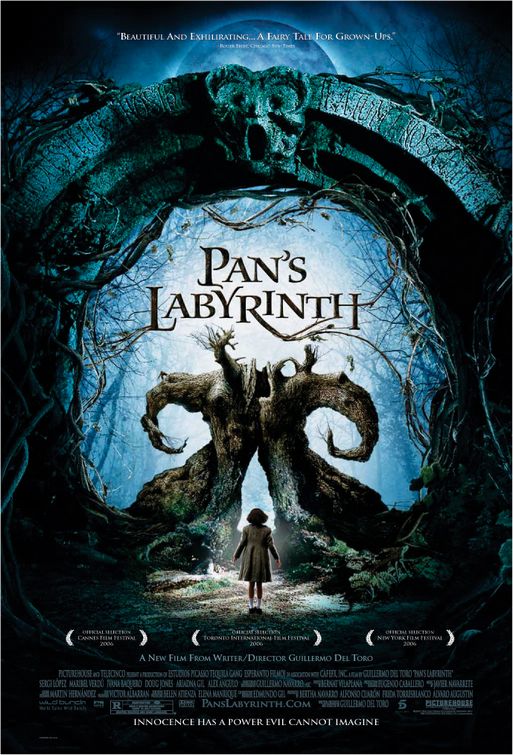
So since the class discussed Pan's Labyrinth and all the "rule of three" references found within the plot, I can't seem to stop thinking about it. So off the top of my head, we mentioned the three trials that Ophelia had to undergo, tehnically there are three noticeable monster figures in the film (the faun, the oversized toad, and the pale man...I don't know if the captain can't substitute one of these because he's not exactly magical), three fairies, three locked chambers in the pale man's domain, I believe Ophelia had to feed the toad three magic rocks, Ophelia used her chalk to draw a portal three different times.....oh when we were on this particular subject, I mentioned a tree, this was the tree I was referring to. I'm not sure if we actually see it in the film or maybe this is the tree in which the toad lived in. However, the shape of the tree kind of resembles two intertwined beings and with Ophelia standing in front of the opening of the tree kind of makes her an element of it, a key in balancing out the composition of the image, thus the rule of three. Female, Male, child? The more I though about it, the more I realized the prominence in this method of story-telling and the overall balance that comes with it. A triangular formation, which can result in three lines being matched up at opposing ends, is a pretty strong structure. Throughout many well-know fairy tales, the rule of three is very popular as well. There were three major candidates for the glass slipper, Cinderella's two sisters and Cinderella herself. There were three little piglets that set off to make it on their own before their encounter with the big bad wolf.
In a pretty recent fairy tale, Shrek, Lord Farquadd had to choose between three potential princesses to be his bride in order for him to finally be King.
In Hocus Pocus, there were three witches.
This may not be fairy tale related, but the Holy Trinity. There were three sisters of the Charmed order in the cult show.
The more I think about, the more it seems like we can pretty much connect this rule of three to anything from the formation of cutlery to stories to the philosophy of an earth-bound life being that there is birth, life, then death....
It's like what Jim Carrey was doing in that movie, The Number 23, (which I've never seen but from the previews) the more thought he put into it, the more he started to see the connection between everything and the number 23. Except my number is three. Just three. Althought I do like the number 2 as well. Oh no. I'm turning into Walter Sparrow.


Friday, March 13, 2009
The elf inspectors of Iceland
This Slate article on the extent to which elves disrupt construction projects in Iceland is especially timely given our upcoming discussion of Lucy Kemnitzer's story "The Boulder."
A "vampire" skull
National Geographic reports on the discovery of a medieval skull in Italy with a brick wedged into its mouth. This was thought to keep vampires from chewing their shrouds, and thus prevent the spread of contagion.
Wednesday, March 11, 2009
Messin' With Sasquatch
From the story "Up the Fire Road", we are presented with our first encounter so far in this course with the alleged ape-man being of Sasquatch. My knowledge of such a creature is, well, very limited. I have always regarded the Sasquatch as a mythical creature. Just as I view the Loch Ness Monster, dinosaurs still existing on earth, and the Tooth Fairy.
However, clearly this is not the case with everyone out there. A look at wiki's definition of Sasquatch yields an extensive description on the beast, down to its weight and behavior tendencies. These result from numerous reported sightings that have taken place over the whole nation for years. I don't want to say that I believe in the Sasquatch, but given the fact that so many detailed sightings have taken place over the course of decades, it does make one wonder if we are all just being, perhaps ignorant(?) to fantastical elements that very well could exist in reality....why should there be any reason for them not to, after all?? (Now I probably sound crazy by saying that....)
Here's the Wiki link:
Also, even more interesting than that link, I present you with the SIS website.
That's right, the Sasquatch Information Society. It is a headquarters website including pictures (which are hilarious....photoshop much?), interviews with dedicated researchers in this area, and a sightings chart.
Alabama has an alleged 51.....that puts us second behind Washington with 499.
WIN.
However, clearly this is not the case with everyone out there. A look at wiki's definition of Sasquatch yields an extensive description on the beast, down to its weight and behavior tendencies. These result from numerous reported sightings that have taken place over the whole nation for years. I don't want to say that I believe in the Sasquatch, but given the fact that so many detailed sightings have taken place over the course of decades, it does make one wonder if we are all just being, perhaps ignorant(?) to fantastical elements that very well could exist in reality....why should there be any reason for them not to, after all?? (Now I probably sound crazy by saying that....)
Here's the Wiki link:
Also, even more interesting than that link, I present you with the SIS website.
That's right, the Sasquatch Information Society. It is a headquarters website including pictures (which are hilarious....photoshop much?), interviews with dedicated researchers in this area, and a sightings chart.
Alabama has an alleged 51.....that puts us second behind Washington with 499.
WIN.
Tuesday, March 10, 2009
Publishing in a Recession
Last week we talked about how the " The Year's Best Horror and Fiction" series has been discontinued as of this year. So in response I did a little digging on how the recession has impacted the literature/book industry. Some argue that books are an inexpensive form of escapism. As far getting a fantasy novel published, the publishing timeline is predicted to take about two years and may just put the novel's debut on the recessions upturn. Some argue that "there will be fewer but better books" on the market. Here are two links. One to a blog directly addressing fiction novels and another addressing the publishing industry in Britain since the recession.
Monday, March 9, 2009
The Donner Party
For this week I am going to be talking about the Year's Best "A Thing Forbidden" which if you haven't read yet involves the cannibalism incident of the Donner Party. I decided to read up on the Donner Party, and found out that the historical account does not exactly line up with the short story. In "A Thing Forbidden," the associates of the Donner Party are portrayed as killers, and the showdown at the end definitely capitalizes on this. When I looked up the Donner Party online though, they only resorted to cannibalism as an imperative last resort to living. There is actually Donner Party Memorial Park in California. I thought this was pretty interesting as I have always thought the Donner Family's story was a murder story like "A Thing Forbidden."
Folklore vs. Fantasy
While doing some research on Don Tumasonis's "The Swing", I did not find a lot about the actual story, but I got started thinking about an interesting question - where should the line be drawn between fantasy and folklore? When I was reading the story, there were obviously fantasy elements within, but they were based on like ancient Native American legends.
So is there a line between what is fantasy and what is folklore?
I did some more research, and now I don't think so. I think they are separate entities, although a lot of folklore involves some fantasy elements. Folklore specifically involves stories passed down orally for many years, while fantasy is everything we described it as at the beginning of the semester. At least, that's the conclusion I've come to. Here's a website I stumbled upon, that while random, was useful.
http://www.ccsd.edu/link/LMS/GENRE/folklore.htm
What do ya'll think?
So is there a line between what is fantasy and what is folklore?
I did some more research, and now I don't think so. I think they are separate entities, although a lot of folklore involves some fantasy elements. Folklore specifically involves stories passed down orally for many years, while fantasy is everything we described it as at the beginning of the semester. At least, that's the conclusion I've come to. Here's a website I stumbled upon, that while random, was useful.
http://www.ccsd.edu/link/LMS/GENRE/folklore.htm
What do ya'll think?
Saturday, March 7, 2009
Origin of the Vampire Mythos
I'm not sure that Stoker or Rice ever touched on this topic, but we can draw an interesting comparison between Vampires in the Lemon Grove and the HBO series True Blood. In Russell's story, the myths about vampires (e.g. sunlight, mirrors, etc.) are of human origin, and function to terrify the vampires against certain actions. In the HBO series, however, these myths were of vampire origin, allowing them to assimilate into human society by secretly sowing the wrong perception of the nature of a vampire. The vampires are empowered in True Blood, but weakened in Russell's version, all due to the origin and intention of their mythos.
Maybe this issue is tackled in Twilight or some other vampire literature, but I'm not aware of any.
Maybe this issue is tackled in Twilight or some other vampire literature, but I'm not aware of any.
Friday, March 6, 2009
Gary McMahan
So I was just looking at Gary Mcmahon's blog and I saw where recently in February he found out his article "The Hills Have Eyes: The Hate Outdoors" would be published in Butcher Knives and Body Counts. This book has essays on slasher films. Could be interesting considering that movie definitely has a few body counts. But I wonder why he would write about slasher films..is he more interested in writing about horror than fantasy??
This question is for you Andy...
This question is for you Andy...
Wednesday, March 4, 2009
Vampires in the Lemon Grove
I found the last part of Vampires in the Lemon Grove very difficult to visualize, since I didn't recognize the funicular.
I admit, though, I overall had difficulty with Lemon Grove - the concept seemed very likable, yet I found the uneven pacing of the backstory intrusions constantly throwing me out of the story. While I recognized the 'falling out of love' allegory on which Lemon Grove is built, it struck me as a muddy connection, weakened by the author's lack of explanation regarding her 'reinvention' of vampires. Did others have this same experience?
I admit, though, I overall had difficulty with Lemon Grove - the concept seemed very likable, yet I found the uneven pacing of the backstory intrusions constantly throwing me out of the story. While I recognized the 'falling out of love' allegory on which Lemon Grove is built, it struck me as a muddy connection, weakened by the author's lack of explanation regarding her 'reinvention' of vampires. Did others have this same experience?
Tuesday, March 3, 2009
Symbols of Fertility
On the subject of mandrakes, which as I was reading the wikipedia's explanation of origin, references, and uses, I was intrigued by the aspect of the mandrake being used as a fertility symbol. This prompted me to find out more about fertility symbols and all things that represent fertiity. There is one theory that the reason behind why women were portrayed more plump and vulupturous in paintings was not only to depict their wealthy-status in society and they looked round because they were eating well, but it was also to signal their fertility as women. Of course, that could just be the surface of reading into a complex painting that may be full of symbols and abstract signs that tell a story. According to the Illustrated Dictionary of Symbols in Eastern and Western Art by James Hall, some of the signs and/or symbols that signify fertility or are associated with fertility are spiral patterns, bulls, fish, goats, rabbits/hares, and ram to name a few. Does anyone know of any more symbols relating to the issue of fertility throughout Greek mythologies or otherwise (legends, folklores, children stories) off the top of their heads?
Sunday, March 1, 2009
Holiday
I found an interview with M.Rickert on Shirley Jackson's blog. In the interview he explains why he wrote "Holiday". Here is the link:
http://shirleyjacksonawards.blogspot.com/2008/06/charles-tan-interviews-m-rickert.html
http://shirleyjacksonawards.blogspot.com/2008/06/charles-tan-interviews-m-rickert.html
Mandrakes
After my questioning about the mandrake in class, I decided to do a little more research...
I know wikipedia doesn't really count as a reliable source...but this page seemed to offer a pretty good summary...
http://en.wikipedia.org/wiki/Mandrake_(plant)
I suppose I can imagine the somewhat human resemblance, maybe not with the picture used on the page. Anyway, I am kind of surprised I never ran across the connections before - mandrakes have been depicted a lot in literature and such. I must say, I do think they are best used when waking up those poor petrified people in Harry Potter :)
I know wikipedia doesn't really count as a reliable source...but this page seemed to offer a pretty good summary...
http://en.wikipedia.org/wiki/Mandrake_(plant)
I suppose I can imagine the somewhat human resemblance, maybe not with the picture used on the page. Anyway, I am kind of surprised I never ran across the connections before - mandrakes have been depicted a lot in literature and such. I must say, I do think they are best used when waking up those poor petrified people in Harry Potter :)
Thursday, February 26, 2009
Skinwalkers
So for my paper I wrote about werewolves' portrayal in fantasy, and I touched a lot on the history of skinwalkers after all the suggestions from class two weeks ago. To my surprise I found A LOT of stuff about them online. My favorite was on Animal Planet's website this short video. http://animal.discovery.com/fantasy-creatures/skinwalker/
I paralleled the skinwalker tradition to Stephenie Meyer's wolf pack in her series. There are a lot of similarities but one huge difference. Skinwalkers scare Natives to death, and they are still a legitimate fear of theirs.
So furthered my quest to YouTube where I found this video which is kind of funny in a way but kind of creepy too. I thought I would share these interesting finds.
I paralleled the skinwalker tradition to Stephenie Meyer's wolf pack in her series. There are a lot of similarities but one huge difference. Skinwalkers scare Natives to death, and they are still a legitimate fear of theirs.
So furthered my quest to YouTube where I found this video which is kind of funny in a way but kind of creepy too. I thought I would share these interesting finds.
Scariest part of the movie
ok, so I wasn't there to discuss Labarinto del Fauno with you guys, and i apologize, but ive got a good, no GREAT excuse. I was interviewing for the position of Entry-Level Bank Examiner with the Office of the Comptroller of the Currency. They are the foremost banking regulatory agency in the USA.
Here's the regulatory hierarchy
OCC>FDIC>State Regs
anyway, spending time working for a regulatory agency is a MUST for anyone who really wants to be a banker and move up in the ranks. (as i do)
plus, i'll be a federal agent and get to wear a suit and tie all the time, the salary isn't bad either. woot
so yeah, high fives!
Pan's Labyrinth (not really Pan but some other random faun) is a haunting and fantastic movie
this is my favorite scene from the movie,
i wanted ophelia to get eaten. she didnt listen to the faun or the fayries, what a bad child!
and those poor fayries get eaten because of her.
but sincerely, the set is exquisite. Notice the sumptous feast, but no other chairs at the table...
the paintings on the cieling are really scary too. Even, the fireplace is creepy with the teeth like metal grate and eye like exhaust vents. the mound of shoes is a nice detail too.
why is this pale man only hungry for children? that ham with pineapple slices on it would suffice for me.
and seriously, WHAT ARE YOU THINKING OPHELIA? you deserved to get eaten and lucked out. i hope you feel bad about the fayries.
interesting parallels to the story of Persephone and Hades though (it's about time she returned to her mom, Demeter)
also, the cattle of Helios and Odysseus' men
one more but i can't think of it offhand...i'll edit it in when i remember
Moral of this episode, don't eat other people's food or you will get stuck in hell or eaten.
Here's the regulatory hierarchy
OCC>FDIC>State Regs
anyway, spending time working for a regulatory agency is a MUST for anyone who really wants to be a banker and move up in the ranks. (as i do)
plus, i'll be a federal agent and get to wear a suit and tie all the time, the salary isn't bad either. woot
so yeah, high fives!
Pan's Labyrinth (not really Pan but some other random faun) is a haunting and fantastic movie
this is my favorite scene from the movie,
i wanted ophelia to get eaten. she didnt listen to the faun or the fayries, what a bad child!
and those poor fayries get eaten because of her.
but sincerely, the set is exquisite. Notice the sumptous feast, but no other chairs at the table...
the paintings on the cieling are really scary too. Even, the fireplace is creepy with the teeth like metal grate and eye like exhaust vents. the mound of shoes is a nice detail too.
why is this pale man only hungry for children? that ham with pineapple slices on it would suffice for me.
and seriously, WHAT ARE YOU THINKING OPHELIA? you deserved to get eaten and lucked out. i hope you feel bad about the fayries.
interesting parallels to the story of Persephone and Hades though (it's about time she returned to her mom, Demeter)
also, the cattle of Helios and Odysseus' men
one more but i can't think of it offhand...i'll edit it in when i remember
Moral of this episode, don't eat other people's food or you will get stuck in hell or eaten.
Wednesday, February 25, 2009
Rejecting the Underworld
Although some people view the ending of this story with the impression that the underworld is real (because, why not? anything can happen in fantasy), for once I have to depart from my ways of embracing the impossible and not accept that such a world actually existed for Ofelia. Rather, it was a fantastical world she imagined for herself as a way to seek escape from the political and personal turmoil around her.
I believe the film itself is structured to support my opinion. Ofelia's fantasies are obviously, just that, dreams and her imagination; nothing in them actually affects the real world, nor does anyone ever actually see the fairies and faun the she continuously seems to encounter. Given the fact that she constantly carries with her stacks of fantasy books, we can assume rationally, not unlike the adults in the movie, that such things have gone to her head.
We can even draw the comparison to Ofelia's namesake, the insane Ophelia from Hamlet who commits suicide. Ofelia's fantasies are a combination of her mad escape from reality and a rebellion and refusal to live in the Captain's world. However, such imaginations, although they resulted in her death, nevertheless were still able to free her. No longer would she be in such a world of turmoil and suffering; she may not have gone to underworld from her fantasies, but we can all agree she at least went to some form of heaven or Utopia that reunited her with her mother and father in a true symbolization of liberation.
Still though, despite all of this, it's fun to believe that such a fantasy land actually existed...wistful thinking, I suppose
I believe the film itself is structured to support my opinion. Ofelia's fantasies are obviously, just that, dreams and her imagination; nothing in them actually affects the real world, nor does anyone ever actually see the fairies and faun the she continuously seems to encounter. Given the fact that she constantly carries with her stacks of fantasy books, we can assume rationally, not unlike the adults in the movie, that such things have gone to her head.
We can even draw the comparison to Ofelia's namesake, the insane Ophelia from Hamlet who commits suicide. Ofelia's fantasies are a combination of her mad escape from reality and a rebellion and refusal to live in the Captain's world. However, such imaginations, although they resulted in her death, nevertheless were still able to free her. No longer would she be in such a world of turmoil and suffering; she may not have gone to underworld from her fantasies, but we can all agree she at least went to some form of heaven or Utopia that reunited her with her mother and father in a true symbolization of liberation.
Still though, despite all of this, it's fun to believe that such a fantasy land actually existed...wistful thinking, I suppose
Navigating the many Labyrinths
One the things that has always amused me is that while my best friend and her girlfriend are huge fans of David Bowie's Labyrinth, I was rather unimpressed with the film (though not David Bowie's hard-to-ignore codpiece). However, I (artsy fartsy film nerd that I am) love Pan's Labyrinth, yet I'm positive I could never get them to watch it.
Obviously, one is best recognized as a star vehicle pop piece and the other as an artistic comment on a number of different issues/conflicts (chief among them the living under Francisco Franco), I'm curious what people think are the similarities. There's a lot of superficial visual cues, but they also have the same basic plot framework: Baby Brother is held hostage in some way and Plucky Older Sister must face down a fantastic authority figure to get him back.
Thoughts?
Obviously, one is best recognized as a star vehicle pop piece and the other as an artistic comment on a number of different issues/conflicts (chief among them the living under Francisco Franco), I'm curious what people think are the similarities. There's a lot of superficial visual cues, but they also have the same basic plot framework: Baby Brother is held hostage in some way and Plucky Older Sister must face down a fantastic authority figure to get him back.
Thoughts?
Another (fictional) moneyless society
From Cory Doctorow's glowing review of Bruce Sterling's new sf novel (boldface emphasis mine):
In The Caryatids, global warming has melted practically every government in the world (except China) -- leaving behind a slurry of refugees, rising seas, and inconceivable misery. But there are two stable monoliths sticking out of the chaos, a pair of "civil society groups" that embody the two major schools of smart green thought today: the Dispensation are Al Gore green capitalists based out of California who understand that glamor and profits, properly aimed, achieve more than any amount of stern determination and chaste conservation; their rivals are the Aquis, mostly European anarcho-techno-geeks who have abandoned money in favor of technologically mediated communal life where giant, powerful, barely controlled machines are deployed to save the refugees and heal the Earth.
The Labyrinth vs. the Graveyard
In Pan's Labyrinth, the final scene of Ofelia alive where she is running through the Labyrinth and it opens for her to allow her to move to the middle faster made me sort of think of Bod moving through fixtures in the Graveyard at will. Both the Graveyard and the Labyrinth acted in a differing way in protecting the children. The main difference being that Bod was allowed to live while Ofelia had to die, even though her death took her to her Utopia.
Tuesday, February 24, 2009
Gaiman's Original Plan for The Graveyard Book
In an interview in another one of his books, Fragile Things, Neil Gaiman said,
The next novel I'm working on is called The Graveyard Book. It's a novel that consists of--I hope, if it works--short stories. Each chapter is a short story set a couple of years apart from the next, so together they form a novel going through somebody's life. It's about a young boy whose family is killed and who takes refuge in a graveyard and is brought up by dead people who teach him all the things that dead people know.I didn't really pay attention to the way that Gaiman wrote each chapter. "The Witch's Headstone," for example, doesn't need too much additional material to be read and understood. I just thought it was interesting that this was his original direction for the book.
Kronos
I'm not sure if I'm right on this but is the monster in the room with the fruit supposed to be Kronos from Greek mythology? I don't really know much about him but I remember talking about him in art history and that he ate his own children. The paintings that were on the wall in the room were of the monster eating what looked like children. I'm not sure if I am right on that though.
Labyrinth
I noticed on the back of the movie case that this director also directed Hell Boy. I really like the first movie, although I have never read the comics. At the end of Pan's Labyrinth when she is lying on the ground and her blood drips into the portal (I know that's a gross description), I noticed that it looked a lot like the part of Hell Boy when the evil blonde girl and that crazy assassin kill that guy in the arctic to bring back their master. Or at least the miniature stone labyrinth on the ground full of blood, they looked very similar to me. Also I liked the part about the mandrake. It reminded me of the mandrakes in Harry Potter and the Chamber of Secrets, but I think I like the way the look in Pan's Labyrinth better.
Dissatisfied
This was the first time I had ever seen Pan's Labyrinth. And besides some pretty gruesome parts, enjoyed it. However, at the end of the movie if felt the story was incomplete. Yes, the story is about Ofelia and the movie ties up her story quite nicely. The fate of Ofelia's baby brother is left to the imagination, with some strong suggestions that he is left in the care of Mercedes. I think at the end I wanted conformation that this child Ofelia sacrificed her life for was taken care of. No dialog would be necessary, just a thirty second clip of him safe with Mercedes and Pedro. Did anyone else find this element lacking?
Labyrinth Recollections
As I was nearing the end of Pan's Labyrinth (which I greatly enjoyed, by the way) I had a couple of flashbacks during the movie and wanted to know if others felt the same.
When Pan tells Ofelia to bring her brother to the labyrinth, for some reason I was reminded of the beginning of the movie Labyrinth when the Goblin King (David Bowie) steals Sara's baby brother away from her. I am not sure why I thought of this, but it definitely rang some bells.
Also, when the captain is chasing Ofelia through the labyrinth, did anyone think of The Shining (the movie, not the book)? I just kept seeing Jack Nicholson stumbling through snowy hedges, haha.
When Pan tells Ofelia to bring her brother to the labyrinth, for some reason I was reminded of the beginning of the movie Labyrinth when the Goblin King (David Bowie) steals Sara's baby brother away from her. I am not sure why I thought of this, but it definitely rang some bells.
Also, when the captain is chasing Ofelia through the labyrinth, did anyone think of The Shining (the movie, not the book)? I just kept seeing Jack Nicholson stumbling through snowy hedges, haha.
Pan's Labyrinth
So I was just looking up the definition for a faun--because before I watched the movie I had never heard of the term--and Wikipedia describes a faun as "place-spirits of untamed woodlands." The creature derives from Roman mythology. It says they have horns and resemble goats below the waist, but resemble humans above.
One difference between this definition of a faun and the one in Pan's Labyrinth was the appearance in Pan's Labyrinth didn't really look like a goat to me. It looked like it had grass growing all over it. And Wikipedia even says that "the faun in this movie is different from most fauns, looking as if it was made of earth and trees rather than just a goat and a man."
One difference between this definition of a faun and the one in Pan's Labyrinth was the appearance in Pan's Labyrinth didn't really look like a goat to me. It looked like it had grass growing all over it. And Wikipedia even says that "the faun in this movie is different from most fauns, looking as if it was made of earth and trees rather than just a goat and a man."
Monday, February 23, 2009
Jim Morrison's grave, 1991
Our classroom discussion of cemeteries as festive gathering places, prompted by Neil Gaiman's The Graveyard Book, inspired me to unearth these photos of Jim Morrison's grave in Pere Lachaise in Paris as it looked during my first visit in 1991. Note the perpetual crowd of celebrants, the offerings left by visitors, and the layers of graffiti on every hard surface for yards around, including all the neighboring tombs.
 Eventually the neighbors' living relatives complained loudly enough that the city cracked down on all this. Now such gatherings are prohibited, and all the graffiti had been scoured off or painted over by my 2003 visit.
 Of all the graffiti I saw, my favorite was this, hard to read in the photo: "Don't spend all your life sitin' [sic] on Jim Morrison's grave."
 Note the perpetual crowd of celebrants, the offerings left by visitors, and the layers of graffiti on every hard surface for yards around, including all the neighboring tombs.
 Eventually the neighbors' living relatives complained loudly enough that the city cracked down on all this. Now such gatherings are prohibited, and all the graffiti had been scoured off or painted over by my 2003 visit.
 Of all the graffiti I saw, my favorite was this, hard to read in the photo: "Don't spend all your life sitin' [sic] on Jim Morrison's grave."
Chris Riddell's "Last dance!"
My copy of the British edition of Neil Gaiman's The Graveyard Book just arrived, courtesy of Amazon UK, and while all Chris Riddell's illustrations are admirable, I thought Kellie Hensley would be especially interested in this one, of Bod sharing the last dance with the Lady on the Grey.

"Out of these moneyless mists"
Zach's paper idea on moneyless economies (Link's "The Hortlak," Star Trek: First Contact, Doctorow's Down and Out in the Magic Kingdom, etc.), reminded me of a famously cranky passage of criticism that I finally have tracked down. It's from Brian W. Aldiss' classic history of science fiction, Trillion Year Spree. Aldiss argues that the great appeal of feudal fantasy landscapes is economic, and that the widespread popularity of fantasy since the 1970s is the result of economic uncertainty:
... Perhaps the most compelling attraction of a feudal background is that money never has to change hands.
We are talking, after all, when we deal with this welter of fantasy, of the dreams of our society, our capitalist society. That society works by the circulation of money. What is the adolescent reader, the typical reader of these fantasies, most short of? Money. And the power that money brings. The attractions of societies where no money changes hands are obvious. A young fantasy hero cast up on a strange planet can go straight into the nearest tavern and obtain a tankard of ale or bexjiquth. When did a fantasy hero ever fish a ten dollar bill from his pocket? When did milady seek alimony? When were travellers’ cheques needed in Atlantis or Cathay? When was the lead villain simply slung into prison for debt? When did the mortgage ever fall due on one of those labyrinthine castles? ...
In fantasies, banks –- those bastions of capitalist society –- are transformed into palaces or castles. Transactions take place in readily negotiable blood. It is not really science which yields to magic in these sagas, but the fiscal system. Hence the reason for their endless popularity. Witchcraft needs no bank loan. And, because such fantasies are always unsatisfying, it is also the reason why publishers need to keep up the supply of the drug, month by month. The Gor novels are for addicts, not adults. When economic policies weigh hardest on the people, dosages can be seen to increase. ...
Out of these moneyless mists come heroes, heroines, and gods to satisfy an insatiable demand, accompanied by wizards, warlocks, unicorns and dragons, dwarves and fairies. It is hard to understand why the contemporary world should so desperately need these antiquated props from earlier ages, unless intellect is less secure on its throne than we had hoped. ...
If we are confronting the untutored consciousness, the unembarrassed outpourings of the mind of the US as it grows towards being the globe’s dominating super-power of the Twenty-First Century –- infinitely more strong, glittering, and expensive than any previous state –- then we confront a mind almost willfully irrational, technophobic, embracing the horrid, bugged by unknown superstition, and hypnotized by the infantile fantasy of owning the universe.
-- Brian W. Aldiss with David Wingrove, Trillion Year Spree: The History of Science Fiction. 1986. Thirsk: House of Stratus, 2001. 322-24. (From Ch. 11, “The Dawn of the Day of the Dumpbin.”)
Sunday, February 22, 2009
The Nature of Labyrinths
So I watched the movie for this week and started to think about labyrinths in general. These can obviously be traced to Ancient Greece and Daedalus and the Minotaur, but what about the modern equivalents? In New England (where I'm from), it's fairly common to outline a labyrinth with various rocks in the shadow of a church or a garden or a new-agey retreat. This is a picture from one fairly close to my home:

That's basically just a classical interpretation: an actual maze in which one can get physically lost. But I'd argue that modern interpretations have moved past this simplicity. Jorge Luis Borges wrote a famous short story titled "The Garden of Forking Paths," in which he argued that the ultimate labyrinth is time, where each decision represents a turn in the maze and no backtracking is possible.
"House of Leaves" by Mark Z. Danielewski is a novel that explores labyrinths more as a concept of horror. At its most basic, the story is about a house that's bigger on the outside than on the inside, eventually branching into a labyrinth. But the main story is layered with editorial notes that are narrated to form an additional story, and those footnotes have yet other authors leaving notes. The complexity increases to the point where the pages of the book are literally re-arranged to take on the subject matter--you have to twist the book sideways and upside-down and skip pages to follow the text. The book is the labyrinth. It pretty much became a cult favorite (think Monty Python and the Holy Grail). If you're not familiar with it, I'll bring my copy on Wednesday for anyone interested to see.

So my musing aside, "Pan's Labyrinth" obviously showcased an ancient labyrinth. But that's looking at things from a pretty basic level. The chalk let Ofelia walk seamlessly between worlds and pass physical boundaries in our own. The story itself seemed more like an inversion of the traditional purpose of the labyrinth, where it eventually allows her to escape rather than trapping her like the Minotaur of Crete. I'd wager that the movie walked the path of these more modern interpretations of the labyrinth, offering a deeper subtext that we could explore.
That's basically just a classical interpretation: an actual maze in which one can get physically lost. But I'd argue that modern interpretations have moved past this simplicity. Jorge Luis Borges wrote a famous short story titled "The Garden of Forking Paths," in which he argued that the ultimate labyrinth is time, where each decision represents a turn in the maze and no backtracking is possible.
"House of Leaves" by Mark Z. Danielewski is a novel that explores labyrinths more as a concept of horror. At its most basic, the story is about a house that's bigger on the outside than on the inside, eventually branching into a labyrinth. But the main story is layered with editorial notes that are narrated to form an additional story, and those footnotes have yet other authors leaving notes. The complexity increases to the point where the pages of the book are literally re-arranged to take on the subject matter--you have to twist the book sideways and upside-down and skip pages to follow the text. The book is the labyrinth. It pretty much became a cult favorite (think Monty Python and the Holy Grail). If you're not familiar with it, I'll bring my copy on Wednesday for anyone interested to see.
So my musing aside, "Pan's Labyrinth" obviously showcased an ancient labyrinth. But that's looking at things from a pretty basic level. The chalk let Ofelia walk seamlessly between worlds and pass physical boundaries in our own. The story itself seemed more like an inversion of the traditional purpose of the labyrinth, where it eventually allows her to escape rather than trapping her like the Minotaur of Crete. I'd wager that the movie walked the path of these more modern interpretations of the labyrinth, offering a deeper subtext that we could explore.
New Paper Topic
Ok, so I just e-mailed Andy about my new paper topic, but I thought I would share it with y'all as well to see what y'all thought, and if anyone had any further ideas. I'm going to explore Ford's choices of songs for The Shadow Year. I'm also going to look at how they relate to Ford's life and the time he grew up in, as well as their relationship to the story. I believe that the songs can show us even more how the story is somewhat autobiographical, and a great look at what was really going on in American suburbia in the 1950s. Let me kow what y'all think!
Friday, February 20, 2009
Cool Site
I was looking through Jeffrey Ford's Blog and found a link to a very useful website. It has close to 1700 older books posted in full text. Just thought it would be nice to share a resource. Forgotten Books
This year's Eaton Conference
In an earlier post, I encouraged y'all to become aware of the many academic conferences where people seriously discuss the things we discuss every week -- and to consider participating in those conferences. Now the schedule of this year's Eaton Science Fiction Conference, at UC-Riverside, has been posted; take a look.
"The Faery Handbag" on BBC Radio 7
This BBC Radio 7 adaptation of Kelly Link's "The Faery Handbag" is available only through the weekend.
More on the Signifcance of White
I hope the topic hasn't been exhausted too much. One of the things I thought about it class but didn't really get the chance to mention -- white is also the color of dress in the traditional images of God. White tends to be used in a lot of religious contexts as well.
In The Shadow Year, Mr. White is, in a way, playing God, if you will. He decides, apparently at random, who lives and who dies within the small town. I just thought that was another interesting correlation.
Also, here's a website with some historical and present significance of different colors. I thought it was rather interesting. Sorry, I can't do that cool link making thing...but I can copy and paste :)
http://www.socyberty.com/Folklore/Historical-Significance-of-Colors.77590
In The Shadow Year, Mr. White is, in a way, playing God, if you will. He decides, apparently at random, who lives and who dies within the small town. I just thought that was another interesting correlation.
Also, here's a website with some historical and present significance of different colors. I thought it was rather interesting. Sorry, I can't do that cool link making thing...but I can copy and paste :)
http://www.socyberty.com/Folklore/Historical-Significance-of-Colors.77590
White Tomb
While doing some research for my paper I noticed that in Harry Potter and the Half-Blood Prince the name of the last chapter is called "The White Tomb". I guess this would connect the color white with nobility. Although we determined that Mr. White was not noble at all.
Wednesday, February 18, 2009
X-Files and Suburbia
All our talk about suburbia and its oft-dark underbelly reminded me of an X-Files episode called "Arcadia," where Mulder and Scully, as a married couple, infiltrate a suburban community that has had a slough of recent murders. It definitely has the eerie Pleasantville vibe, and I'd suggest that its mystery/suspense elements mirror Ford's book well enough to warrant a comparison.

Talk about a facade (at that point in the show, at least). Also, the aliases that Mulder and Scully chose for this undercover assignment were taken from The Dick Van Dyke Show.
Talk about a facade (at that point in the show, at least). Also, the aliases that Mulder and Scully chose for this undercover assignment were taken from The Dick Van Dyke Show.
Zombies
Even though this story has nothing to do with zombies, there are "zombies" in the story. Just thought that was interesting.
Stating the Obvious
It is obvious, but interesting how different authors and stories all incorporate a "library." As I read about Perno Shell I could not help, but think of the "The Library" in Magic for Beginners. Two beloved tales that are unmarked and must be sought out. Not to mention the occurances in the library that are essential to the overall plot of the story. I don't know exactly why this is. Maybe it is because writers are very attached to libraries. Or maybe it is because it is a border place between reality and the contents of a book. Or maybe it is just a cool place to set a scene.
The Protagonist
Did it bother anyone else that the name of the main protagonist is never revealed? It seemed like he was inundating us with all these details about everyone who lived in this town, almost to the point where it was hard to keep who was who straight, but we never know the name of the main character in the story. I suppose it makes sense, given the story is from his perspective, and I also think it adds to the mysterious feel of the story, but it still was the one thing that bothered me when I got to the end.
Ford on His Own "Shadow Year"
I don't think I have quite read anything like The Shadow Year before. It was interesting, although i'm not sure I would call it "an obvious fantasy" by any means.
Honestly, I still can't figure out what the hell is going on. I mean, I have interpreted Ford's work to fit my own perception of what it means to me, but I am almost positive it has a completely different meaning to him; it has to, seeing as how personal it is to him and how it originally was a memoir-ish creation. I also looked for the "Botch Town" novella online, but I can't seem to locate it.
But anyways, I went looking for Ford's own take on his novel and found these quotes from his on his work:
"A lot of the Shadow Year is based on my life--it's very personal. I started writing it and then I got stuck. It wasn't anything too traumatic, but I wanted to really get down what had happened."I wish we knew what exactly was personal about this story for him. Was it the characters? I could see them passing as believable people, mostly the mom. Or was it the events? While slightly....more difficult for me to image actually happening in real life, they would definitely be traumatic. (A pedophiliac ice cream man turned clown? Holy crap, that's terrifying). Or perhaps it was just based off of little things like the play-village in the basement or the school projects that could have existed in Ford's childhood.
"The first time I finished The Shadow Year, it was too subtle. Nobody could figure out what the hell was going on. Then, with a lot of encouragement from my editor, I went back to it. She said, 'Here's the secret: it's fiction. Make it a story.' So when I went back I kept that in mind, and that allowed me to finish it. Before that it was really kind of a memoir (god forbid). It's based on the novella 'Botch Town'."
Honestly, I still can't figure out what the hell is going on. I mean, I have interpreted Ford's work to fit my own perception of what it means to me, but I am almost positive it has a completely different meaning to him; it has to, seeing as how personal it is to him and how it originally was a memoir-ish creation. I also looked for the "Botch Town" novella online, but I can't seem to locate it.
Ford seems a very mysterious author and person to me. His own website is very....simplistic, and I wasn't able to find too many interviews with him out there. While it annoys me because I want to know why his book was written how it was and what it meant to him, I can accept his secretive ways just because it gives respect to his work almost by leaving it with such an anonymous atmosphere around it.
Tuesday, February 17, 2009
Golden Compass?
I'm not really sure where the thread about the Golden Compass went, but I was commenting and all the sudden it vanished. I was going to say, "How exactly was the Magisterium involved in the story? I have not seen the movie or read the book, but obviously it was frowned on by most Christian denominations rather publicly. The Magisterium is the teaching authority of the Catholic Church over its entirety that has been handed down in the lineage of popes and bishops since Peter and the apostles. So it would be a symbol of the Catholic Church. Any insight?"
Futuristic Sci-Fi
I mentioned this show in class last week, and received a bunch of blank stares. I wanted to share the wealth with you all. Fringe is a new hit show based on the job of FBI agent Olivia Dunham. She is assigned to freak cases that seem too impossible to be real. The show attempts to explain these phenomena by stretching scientific evidences and hypotheses. Here is a link the the show's site and a link to the episode featuring the "werewolf."
http://www.fox.com/fringe/
http://www.hulu.com/watch/56018/fringe-the-transformation
http://www.fox.com/fringe/
http://www.hulu.com/watch/56018/fringe-the-transformation
Sunday, February 15, 2009
"The New Mother" by Lucy Clifford
In this interview with The Toronto Star, Neil Gaiman says Coraline was partially inspired by "The New Mother" by Lucy Clifford (1882), which he calls "haunting like a nightmare is haunting." Indeed it is. Here's the text.
Gaiman on scary children's stories
From this Montreal Mirror interview about Coraline:
Adults are always much more disturbed by Coraline, because I think it’s a different genre of book for them. From a kid’s-eye view, it’s an adventure. It’s about a little girl who goes up against something bad and wins, and they never have any doubt that she’ll get into trouble, and it’s cool, it’s okay, it’s like The Wizard of Oz. Adults, on the other hand, are reading about a child in danger, and a child in danger is a much stranger, more difficult field of literature to cope with, I suspect. Once you’re a parent, reading about a child in danger is really problematic.Maybe The Graveyard Book, then, isn't as scary to y'all because you aren't parents yet.
The Dragon Book
I've posted to my own blog John Jude Palencar's cover for The Dragon Book, an anthology I'm proud to be in, due in November from Penguin Putnam. Take a look if you're interested.
Stephen King on Stephenie Meyer
A few weeks back, Stephen King commented on the Rowling/Meyer phenomenon. I found it amusing, considering this class' obsession with both authors. I suppose the Harry Potter fans should feel vindicated now.
And this is completely unrelated to anything, but since I know about Mr. Duncan's fetish for Elijah Wood, I figured he would find this video particularly distressing:
(I'm going through a Eurodance phase right now, so forgive me)
"...I think that I serve that purpose [of influencing] some writers, and that’s a good thing. Both Rowling and Meyer, they’re speaking directly to young people. ... The real difference is that Jo Rowling is a terrific writer and Stephenie Meyer can’t write worth a darn. She’s not very good."
And this is completely unrelated to anything, but since I know about Mr. Duncan's fetish for Elijah Wood, I figured he would find this video particularly distressing:
(I'm going through a Eurodance phase right now, so forgive me)
Thursday, February 12, 2009
I have been reading too many reviews lately, and my brain is filled with things.
Since someone requested it, the post I was referencing in class:
Usually, when an article begins "A lot of fans are basically fans of fandom itself," it is a sign of hope--someone who understands active fan culture beyond the shallow "lolnerds." However, it saddened me that the rest of the review, Roger Ebert's look at the movie Fanboys, didn't deliver; instead, Ebert chose to uncritically focus on the loud extremes while criticizing a movie whose biggest fault is uncritically parroting a stereotype. (I haven't seen Fanboys, nor do I intend to, so I don't have an opinion on Ebert's view of the movie.)
One of the things I value most about fandom, and why I love going to conventions is experiencing the love others have for their chosen interests. I don't care what it is, as long as you love it intelligently, seeing both the good and bad. This is, in part, what I have enjoyed most about reading reviews of Takashi Miike's latest true "labor of love", Yatterman--that Miike's exuberance for the original material has shown through, even as he's also not afraid to get in a few jabs. Quoting from the Twitchfilm review by Grady Hendrix:
The problem with Gollum is not that he loved an object too much, after all. It's that he become obsessed with being its sole possessor and arbiter of its existence.
-----
In relation to my paper, I see Link's killing of Fox as forcing Jeremy to examine his own "childish" fannishness, which wishes to immaturely posses the media work he loves. In being given the chance to interface with the work, learns to enjoy and grow with the experience, entering into "mature" fannish culture.
Also, since I discovered it through The Google, this post does a fantastic job of synthesizing fannish experience with Link's story (as well as explaining why I, a child of modern fandom, love it so much).
Usually, when an article begins "A lot of fans are basically fans of fandom itself," it is a sign of hope--someone who understands active fan culture beyond the shallow "lolnerds." However, it saddened me that the rest of the review, Roger Ebert's look at the movie Fanboys, didn't deliver; instead, Ebert chose to uncritically focus on the loud extremes while criticizing a movie whose biggest fault is uncritically parroting a stereotype. (I haven't seen Fanboys, nor do I intend to, so I don't have an opinion on Ebert's view of the movie.)
One of the things I value most about fandom, and why I love going to conventions is experiencing the love others have for their chosen interests. I don't care what it is, as long as you love it intelligently, seeing both the good and bad. This is, in part, what I have enjoyed most about reading reviews of Takashi Miike's latest true "labor of love", Yatterman--that Miike's exuberance for the original material has shown through, even as he's also not afraid to get in a few jabs. Quoting from the Twitchfilm review by Grady Hendrix:
In an interview, Miike talked about the way that Yatterman offered reassurances when it aired only 30 years after the war. He felt like it was a message from adults to kids that everything was going to be alright. No matter how many battles were fought or how many mushroom clouds rose up in the sky, next week things were going to be fine again so don’t worry. It’s not the end of the world.These juxtaposed impulses of condemnation and comfort are what I think Ebert (and most people who look in at fandom from a distance) misses with his analysis of fannish culture. It's not just the social interaction shortcut but the sense of a safe identity and community that cannot be invalidated. As a culture has fewer and fewer large-scale shared experiences, shared fannishness can ensure that even when one can't always live up to the standards of society, there will be a space for them. Yet when this community space becomes a tool for exclusiveism--when fannish Gollums try to deny their fellows the experience and identity in which they revel--it morphs from an experience to a possession, kept forever "perfect" by being polybagged in its original clamshell packaging.
By embracing the repetitive nature of the original Yatterman, Miike’s telling us that it’s the things we do over and over again that are keeping us immature and stop us from growing up, but they’re also our protection against a tough old world. That teddy bear you’ve kept since you were a kid IS childish and immature, but isn’t he sort of your best friend, too? Yatterman points out the problems, but also celebrates the comfort they provide. In a world that feels like it’s rapidly spinning down the toilet, it’s nice to have an adult come in the room and tell all of us that hey, don’t worry, no matter what we do everything’s going to be just fine.
The problem with Gollum is not that he loved an object too much, after all. It's that he become obsessed with being its sole possessor and arbiter of its existence.
-----
In relation to my paper, I see Link's killing of Fox as forcing Jeremy to examine his own "childish" fannishness, which wishes to immaturely posses the media work he loves. In being given the chance to interface with the work, learns to enjoy and grow with the experience, entering into "mature" fannish culture.
Also, since I discovered it through The Google, this post does a fantastic job of synthesizing fannish experience with Link's story (as well as explaining why I, a child of modern fandom, love it so much).
Apologies and Questions
First, I want to apologize once again for missing everyone's presentations yesterday - from what I have heard before class and what Natalie told me about, everyone's papers sound really interesting.
Also, I have a few questions about the actual...style, I guess, of the papers. Like I said, my paper is going to be comparative. It has been quite a while since I have written a class paper, and I definitely feel a little rusty starting out. What types of sources are most likely going to be useful when writing these? I was planning to first compare/contrast different definitions of immortality from a fantasy perspective, then compare/contrast the ways it is portrayed in the sources I choose to use. Hopefully I will also be able to include some information on the author's thoughts on the topic. Does this sound appropriate? I just don't want my paper to end up too informal or anything. I don't know if this was discussed anymore in class yesterday.
Again, thanks for the ideas for sources, I am very sorry for not getting to stay for everyone's proposal, and thanks in advance for helping me with this question!
Also, I have a few questions about the actual...style, I guess, of the papers. Like I said, my paper is going to be comparative. It has been quite a while since I have written a class paper, and I definitely feel a little rusty starting out. What types of sources are most likely going to be useful when writing these? I was planning to first compare/contrast different definitions of immortality from a fantasy perspective, then compare/contrast the ways it is portrayed in the sources I choose to use. Hopefully I will also be able to include some information on the author's thoughts on the topic. Does this sound appropriate? I just don't want my paper to end up too informal or anything. I don't know if this was discussed anymore in class yesterday.
Again, thanks for the ideas for sources, I am very sorry for not getting to stay for everyone's proposal, and thanks in advance for helping me with this question!
Wednesday, February 11, 2009
Thoughts
This is a little late but here is what I've been thinking about for my paper. I am really interested in the art and art references in The Graveyard book. My first inclination is to write about the Dance Macabre - Its origins, its purpose in Gaiman's book, and its modern applications. As far as modern applications I would not limit it to just fantasy examples but not-fantasy references and non-literary references. Secondly, I am interested in the impact art has on a literary piece. Which comes first the picture or the book. And how cover art/inside art enhances or detracts from the book. My concern with the second idea is its lack of concrete evidence and its emphasis on opinion.
Is There Such a Thing As Too Much Harry?
It is an obvious fact, whether you like the books or not (although you would be rather insane not to...) that Harry Potter will indeed go down in history as one of the greatest phenomenon ever. While the movies may eventually get pushed to the back of the DVD stand, it is clear that the books will forever remain well-read, by this generation and many to come.
However, how far are the media and corporations willing to go to continue making a profit off this series, despite it being finished? Turning the books into movies was a given. JKR's extension of books within the books ("Quidditch Through the Ages, Fantastic Beasts and Where to Find Them, Beedle the Bard) was predicted. Even board games, clothing, and other products like the production of actual chocolate frogs and BB's Ever Flavor Beans was to be expected.
However, the kicker for me is Universal's great undertaking to build "The Wizarding World of Harry Potter Theme Park". At a predicted cost of $265 million dollars, it is set to open June of 2010. The park is set to include the areas of Hogsmeade, Hogwarts Castle, and the Forbidden Forest, and it is to encompass various elements from books 1 through 7. JKR herself is even involved with the production (thank god).
So, is this too far? Should an actual, physical representation of the world I came to live in figuratively during my childhood be allowed to become materialized in front me, sans the main element that truly makes it in the books: magic? I feel it would cheapen these places you can never do justice in real life by building.
However, I stand before you as the biggest hypocrite ever. Does this theme park disgust me? Oh, most definitely. It's repulsing. Will I go when it opens? Oh, I've already got my ticket paid for, so watch out. In the end, I'm just as bad as corporations like WB I guess, because I fall right into that trap where I'm willing to shill out good money to see something like this.
And here may be the best thing yet:
Here is a link to concept art of what the park would look like
Pretty much the shit, no?
And Here is an example of what Warner Bros actually has produced
Fail.
So what are everyone else's thoughts on this?
Tuesday, February 10, 2009
The Graveyard Book as a Children's Story
I was searching over Gaiman's blog and found this nugget. It was written in 2004, before he had completed the book. I thought this would be relevant to the discussion we were having last week regarding the degree to which it is a book for children. I wonder if Gaiman succeeded in creating the kind of "deeply scary" story he initially sought, or if the work tempered this ambition.
... And then once I've finished ANANSI BOYS (a novel for adults) I'll write THE GRAVEYARD BOOK (a novel for kids).
The strange thing is that I suspect that THE GRAVEYARD BOOK (a kids book) will have much more sex, more death, and be deeply scarier on most levels than ANANSI BOYS (an adult book). ANANSI BOYS is, at least so far, a huge big funny enthusiastic puppy of a book that just wants to be loved, and will probably be pressed on kids by librarians. THE GRAVEYARD BOOK will be something else -- something really creepy and cool, I hope. The first few pages of THE GRAVEYARD BOOK (more or less all that exists) follows a serial killer called Jack around the empty house in which he's just killed everyone in the family but the baby. He's looking for the baby.
Psychonauts
Back when we were discussing definitions of fantasy and listing examples, I realized that I'd totally forgotten one of my favorite video game examples: Psychonauts. The basic plot is pretty simple: Raz, a cadet at a summer camp for psychics, discovers that his fellow campers' brains are being stolen for use in psychic death tanks. To stop this, he must journey into the warped minds of other, including his enemies, to stop the brain theft.
Playing Psychonauts is very reminiscent of reading a Kelly Link story, though the plot of Psychonauts is far more coherent. Each deranged step is more fun than the next, and the art direction does a great job moving from static concept of living world. Many of the worlds are riffs on pop culture or references to bits fo the creators' own childhoods.
And if you don't believe me, the Zero Punctuation review does a great job encapsulating why the game is so good. (Please note, the audio for this review is not exactly SFW.)
Playing Psychonauts is very reminiscent of reading a Kelly Link story, though the plot of Psychonauts is far more coherent. Each deranged step is more fun than the next, and the art direction does a great job moving from static concept of living world. Many of the worlds are riffs on pop culture or references to bits fo the creators' own childhoods.
And if you don't believe me, the Zero Punctuation review does a great job encapsulating why the game is so good. (Please note, the audio for this review is not exactly SFW.)
Subscribe to:
Posts (Atom)


