So far I am loving this series. I feel like this is one of the best things we have read all semester. I love all of the witty things that Tiffany says.
"It's quite easy to accidentally overhear people talking downstairs if you hold an upturned glass to the floorboards and accidentally put your ear to it."
-Tiffany; Hat Full of Sky
Just one of the many things that she says that I love.
Tuesday, March 31, 2009


Monday, March 30, 2009
Pratchett's Definition of Fantasy
I'm not sure if everyone's copy of Hat Full of Sky has this in it, but mine includes an extra interview with Terry Pratchett in the back. Pratchett is asked, "The fantasy genre is ofter thought of as escapism, but is it escapism with a firm root in reality?" He goes on about escapism, but ends by saying, "Fantasy--the ability to envisage this world in many different ways--is one of the skills that makes us human." I really like this definition and liked that it is somewhat different from what we touched on in class and on the blog. Just thought I'd share.
Good Omens
While reading some background info on Terry Pratchett, I ran across mention of Good Omens, a Terry Pratchett/Neil Gaiman collaboration that is supposedly a funny take on the apocalypse on Earth. Has anyone read this? It sounds like it might be worth looking into.
Sunday, March 29, 2009
Explanations for Magical/Supernatual Occurrences....
While reading through The Wee Free Men, Chapter 4 coincidentally titled "The Wee Free Men" stuck out to me. In this particular chapter, Tiffany flashed back to when Granny Aching was still alive and one of the stunts that she pulled after the Baron pleaded with her to save his sheep-killing dog. This passage can be found from page 105-111. The dog originally would have been placed under the death penalty for such wrongful behavior because of the old laws on the Chalk, but the Baron pleaded with Granny Aching to find a way to save his dog from such fate. After numerous pleas, one of which was by the Baron himself, Granny Aching came up with a solution for this problem. The dog was to be shut in a room with a ewe and her newborn lamb. Everyone watching was baffled by this Granny Aching's solution, but after a few minutes it was clear that the dog has learned his brutal lesson for killing a sheep. Granny Aching was able to teach the dog a lesson without having it killed. All of the townspeople were amazed when they realized what happened. Later, it was found out that what Granny Aching did was just an old shepard trick and that there was no magic involved at all. "That was how it worked. No magic at all. But that time it had been magic. And it didn't stop being magic just because you found out how it was done..." (Prachett 111).
The fact that it did not stop being a magical occurrence just because Tiffany found out the explanation behind Granny Aching's actions reminded me of the end of "The Hill" by Tanith Lee from The Year's Best Fantasy and Horror 2008. Halfway through, I thought it was going to be a short about the walking dead. However, the explanation provided by Miss A at the end about the lizards' role in sacred death practices where they would seek out corpses to possess and dance in took away some of the suspense and mystery that would have been present had she not found out the logical and reasonable explanations behind it all. But according to Tiffany Aching, shouldn't it just as supernatural or magical even if you found out how and why it happened afterwards? Especially if you presumed it to be magical or supernatural in the first place. Why should anything change just because there is now a logical explanation for the occurence if your initial reaction happened to be based on the belief that it was magic or supernatural. I suppose it is up to each person to decide how much importance to place on the reasonable explanation behind something seemingly unexplainable and how it affects their initial beliefs. I personally think it would be nice to look at a situation from all angles, but it should not have to change what I initially believed about the situation and that could be ignorance on my part but that is up to my discretion. I'll accept the other explanations, but the final decision on how to perceive a situation is up to me and I agree with Tiffany Aching. Which way would you choose to go if you found out something that could change your initial gut decision?
The fact that it did not stop being a magical occurrence just because Tiffany found out the explanation behind Granny Aching's actions reminded me of the end of "The Hill" by Tanith Lee from The Year's Best Fantasy and Horror 2008. Halfway through, I thought it was going to be a short about the walking dead. However, the explanation provided by Miss A at the end about the lizards' role in sacred death practices where they would seek out corpses to possess and dance in took away some of the suspense and mystery that would have been present had she not found out the logical and reasonable explanations behind it all. But according to Tiffany Aching, shouldn't it just as supernatural or magical even if you found out how and why it happened afterwards? Especially if you presumed it to be magical or supernatural in the first place. Why should anything change just because there is now a logical explanation for the occurence if your initial reaction happened to be based on the belief that it was magic or supernatural. I suppose it is up to each person to decide how much importance to place on the reasonable explanation behind something seemingly unexplainable and how it affects their initial beliefs. I personally think it would be nice to look at a situation from all angles, but it should not have to change what I initially believed about the situation and that could be ignorance on my part but that is up to my discretion. I'll accept the other explanations, but the final decision on how to perceive a situation is up to me and I agree with Tiffany Aching. Which way would you choose to go if you found out something that could change your initial gut decision?
Cormorants
In The Hide, the color changing birds from the beginning of the story that the three birdwatchers are warned of are said to be cormorants. These are also the birds in the ending that storm the hut where Richard and Clare have waded out to, and they eventually transform into cormorants. I had never heard of a cormorant, so I decided to look it up. I expected to find maybe some negative folklore associated with them, but actually they have been viewed as symbols of Christianity in the past. I found this perplexing as they are presumed to be demons in this story. An interesting paradox.
Thursday, March 26, 2009
Scene from The Wee Free Men
In The Wee Free Men there is a scene inspired by a Richard Dadd painting called The Fairy Feller's Master-Stroke. Click to see the Picture. I just noticed also that chapter 10 is titled "Master Stroke" just as a hint to an attentive reader (which I was not). Pratchett mentioned this in the Author's note at the end of the book. I would recommend giving the one page a quick read (I felt that it gave a small look in the type of person that Pratchett is to go along with his writing).
Wednesday, March 25, 2009
The Evolution of Trickster Stories
Kij Johnson
This short story is filled to the brim with lessons, thought provoking ideas, and morals. When I first began reading it I thought it was just really strange and didn't think I would end up liking it very much. But though I did not like or enjoy the story very much, I respect the amount of thought and detail put into this short work.
I kept thinking of that show on Animal Planet, about like the animal cops, this story reminded me of how cruel people are to their pets sometimes. And it makes me wonder how all our pets would react if they could think, remember, speak. At the beginning Johnson mentions that there was this "Change" and all the domesticated animals started talking. While this story is about dogs, what if the cows and chickens had started thinking and talking. There are more cows in California than there are people, and what if they all decided they didn't want to be raised to be eaten by us anymore. I think we would find ourselves in the midst of a revolution. Cows and chickens vs. United States.
Another theme in this work is the idea of gender duplicity. In the dogs' stories, the "one dog" is usually a female unless the story involves mating, in which case it is a male. I take this to mean that these stories represent all dogs, male and female. However in 9. the "one dog's" sex changes in the first two sentences, it starts out a male dog, and then the other dogs are making fun of "her." Now this could be a typo, but if it isn't, then it's alluding to this whole gender question we have seen in other works throughout this semester.
There is also the idea of these trickster stories being the history for dogs as a race. They have begun to speak and to remember and so I think, have become a little more than just a species. They now have their own stories and the remember them. Reminds me of ancient human history that was passed down by word of mouth, and how ancient stories were told by and remembered solely by memory of the story tellers.
This is such a creative idea for a story. What if your pets started to talk? Think you would be able to keep your fish cooped up in his fishbowl still? Do you think you could live with a pet dog that could remember, think, and talk to you when you punished it?
This short story is filled to the brim with lessons, thought provoking ideas, and morals. When I first began reading it I thought it was just really strange and didn't think I would end up liking it very much. But though I did not like or enjoy the story very much, I respect the amount of thought and detail put into this short work.
I kept thinking of that show on Animal Planet, about like the animal cops, this story reminded me of how cruel people are to their pets sometimes. And it makes me wonder how all our pets would react if they could think, remember, speak. At the beginning Johnson mentions that there was this "Change" and all the domesticated animals started talking. While this story is about dogs, what if the cows and chickens had started thinking and talking. There are more cows in California than there are people, and what if they all decided they didn't want to be raised to be eaten by us anymore. I think we would find ourselves in the midst of a revolution. Cows and chickens vs. United States.
Another theme in this work is the idea of gender duplicity. In the dogs' stories, the "one dog" is usually a female unless the story involves mating, in which case it is a male. I take this to mean that these stories represent all dogs, male and female. However in 9. the "one dog's" sex changes in the first two sentences, it starts out a male dog, and then the other dogs are making fun of "her." Now this could be a typo, but if it isn't, then it's alluding to this whole gender question we have seen in other works throughout this semester.
There is also the idea of these trickster stories being the history for dogs as a race. They have begun to speak and to remember and so I think, have become a little more than just a species. They now have their own stories and the remember them. Reminds me of ancient human history that was passed down by word of mouth, and how ancient stories were told by and remembered solely by memory of the story tellers.
This is such a creative idea for a story. What if your pets started to talk? Think you would be able to keep your fish cooped up in his fishbowl still? Do you think you could live with a pet dog that could remember, think, and talk to you when you punished it?
While reading Sir Hereward and Mister Fitz Go To War Again, I kept trying to envision Mister Fitz - yet with every description, my view of him evolved from Disney-Pinocchio to Carlo Collodi-Pinocchio. So imagine my surprise when I found there is a version with illustrations. It's not exactly how I envisioned, much "simpler," but I like it anyway.
The Boulder and the Holy Grail
The Boulder is introduced as an Icelandic folktale, however I think it is another rendition of the holy grail myth. The "uncle" is on a "quest" to find a missing grail so he can return it to the Huldur folk who live in the boulder. The Huldur folk were the rightful owners of the cup, similar to the rightful protectors of the holy grail (ie: Joseph d' Arimethea by Robert de Bron). The uncle seems to be the type of a grail hero in this tale as Perceval and Galahad are in other tales. The grail's associaion with a pagan temple is similar to Welsh myths of the search for a magic cauldron with magical properties. A significant difference between the Boulder and the Grail myths, is the perspective. In grail myths is stated early on that they characters are in search of a holy grail. In the Boulder the search for the grail is revealed only after the grail has been found.
Tuesday, March 24, 2009
What If...
I was reading The Evolution of Trickster Stories Among the Dogs of North Park After the Change by Kij Johnson, and it made me wonder a little. If my dogs could talk, would I treat them the same? Would they still make me happy just from seeing their reaction as I open the front door of my house? This story made me think more than any other story from this collection, but probably only because I could find an easy way to it. I really liked this story because it found that place in my heart that my dogs will always hold (as long as they can't talk?).
Monday, March 23, 2009
Ahh! Fake Monsters
I was thinking about the Joe Hill book today and I started thinking about monsters. I don't know if anyone ever watched Scooby Doo but remember watching it when I was little and I would get mad because everyone of those monsters just turned out to be some creepy old guy trying to steal some money. I never really thought about that till now. I also remember seeing The Village in high school by M. Night Shyamalan. Those red cloaked monsters were so scary and cool till it turned out to be the paranoid elders of the village trying to keep people from leaving. I know this is a completely random blog but this is stuff that has always bothered me.
Nac Mac Feegles
I know that I'm getting a little ahead of schedule here, but I have been reading Teri Pratchett's books, and decided to learn a little bit more about Nac Mac Feegles.
They initially struck me as a little strange, because they remind me so much of fairies. However, they act more like the pirate crew in the, "Pirates of the Carribean," trilogy. Here is a link to site that examines and describes a little more about Nac Mac Feegles. The more you research the more they seem to be a montage of many different cultures and stories all put together in tiny little men. There are several cultural undertones associated with the Nac Mac Feegles.
http://en.wikipedia.org/wiki/Nac_Mac_Feegle
They initially struck me as a little strange, because they remind me so much of fairies. However, they act more like the pirate crew in the, "Pirates of the Carribean," trilogy. Here is a link to site that examines and describes a little more about Nac Mac Feegles. The more you research the more they seem to be a montage of many different cultures and stories all put together in tiny little men. There are several cultural undertones associated with the Nac Mac Feegles.
http://en.wikipedia.org/wiki/Nac_Mac_Feegle
Saturday, March 14, 2009
The number three and all that it may bring...
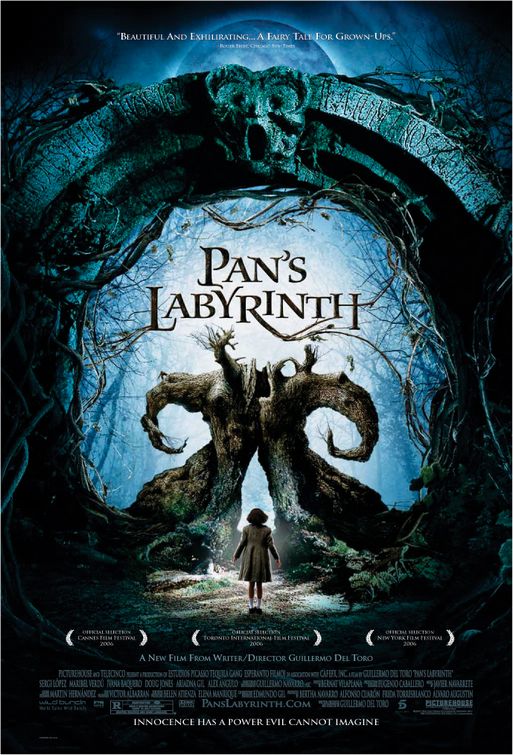
So since the class discussed Pan's Labyrinth and all the "rule of three" references found within the plot, I can't seem to stop thinking about it. So off the top of my head, we mentioned the three trials that Ophelia had to undergo, tehnically there are three noticeable monster figures in the film (the faun, the oversized toad, and the pale man...I don't know if the captain can't substitute one of these because he's not exactly magical), three fairies, three locked chambers in the pale man's domain, I believe Ophelia had to feed the toad three magic rocks, Ophelia used her chalk to draw a portal three different times.....oh when we were on this particular subject, I mentioned a tree, this was the tree I was referring to. I'm not sure if we actually see it in the film or maybe this is the tree in which the toad lived in. However, the shape of the tree kind of resembles two intertwined beings and with Ophelia standing in front of the opening of the tree kind of makes her an element of it, a key in balancing out the composition of the image, thus the rule of three. Female, Male, child? The more I though about it, the more I realized the prominence in this method of story-telling and the overall balance that comes with it. A triangular formation, which can result in three lines being matched up at opposing ends, is a pretty strong structure. Throughout many well-know fairy tales, the rule of three is very popular as well. There were three major candidates for the glass slipper, Cinderella's two sisters and Cinderella herself. There were three little piglets that set off to make it on their own before their encounter with the big bad wolf.
In a pretty recent fairy tale, Shrek, Lord Farquadd had to choose between three potential princesses to be his bride in order for him to finally be King.
In Hocus Pocus, there were three witches.
This may not be fairy tale related, but the Holy Trinity. There were three sisters of the Charmed order in the cult show.
The more I think about, the more it seems like we can pretty much connect this rule of three to anything from the formation of cutlery to stories to the philosophy of an earth-bound life being that there is birth, life, then death....
It's like what Jim Carrey was doing in that movie, The Number 23, (which I've never seen but from the previews) the more thought he put into it, the more he started to see the connection between everything and the number 23. Except my number is three. Just three. Althought I do like the number 2 as well. Oh no. I'm turning into Walter Sparrow.


Friday, March 13, 2009
The elf inspectors of Iceland
This Slate article on the extent to which elves disrupt construction projects in Iceland is especially timely given our upcoming discussion of Lucy Kemnitzer's story "The Boulder."
A "vampire" skull
National Geographic reports on the discovery of a medieval skull in Italy with a brick wedged into its mouth. This was thought to keep vampires from chewing their shrouds, and thus prevent the spread of contagion.
Wednesday, March 11, 2009
Messin' With Sasquatch
From the story "Up the Fire Road", we are presented with our first encounter so far in this course with the alleged ape-man being of Sasquatch. My knowledge of such a creature is, well, very limited. I have always regarded the Sasquatch as a mythical creature. Just as I view the Loch Ness Monster, dinosaurs still existing on earth, and the Tooth Fairy.
However, clearly this is not the case with everyone out there. A look at wiki's definition of Sasquatch yields an extensive description on the beast, down to its weight and behavior tendencies. These result from numerous reported sightings that have taken place over the whole nation for years. I don't want to say that I believe in the Sasquatch, but given the fact that so many detailed sightings have taken place over the course of decades, it does make one wonder if we are all just being, perhaps ignorant(?) to fantastical elements that very well could exist in reality....why should there be any reason for them not to, after all?? (Now I probably sound crazy by saying that....)
Here's the Wiki link:
Also, even more interesting than that link, I present you with the SIS website.
That's right, the Sasquatch Information Society. It is a headquarters website including pictures (which are hilarious....photoshop much?), interviews with dedicated researchers in this area, and a sightings chart.
Alabama has an alleged 51.....that puts us second behind Washington with 499.
WIN.
However, clearly this is not the case with everyone out there. A look at wiki's definition of Sasquatch yields an extensive description on the beast, down to its weight and behavior tendencies. These result from numerous reported sightings that have taken place over the whole nation for years. I don't want to say that I believe in the Sasquatch, but given the fact that so many detailed sightings have taken place over the course of decades, it does make one wonder if we are all just being, perhaps ignorant(?) to fantastical elements that very well could exist in reality....why should there be any reason for them not to, after all?? (Now I probably sound crazy by saying that....)
Here's the Wiki link:
Also, even more interesting than that link, I present you with the SIS website.
That's right, the Sasquatch Information Society. It is a headquarters website including pictures (which are hilarious....photoshop much?), interviews with dedicated researchers in this area, and a sightings chart.
Alabama has an alleged 51.....that puts us second behind Washington with 499.
WIN.
Tuesday, March 10, 2009
Publishing in a Recession
Last week we talked about how the " The Year's Best Horror and Fiction" series has been discontinued as of this year. So in response I did a little digging on how the recession has impacted the literature/book industry. Some argue that books are an inexpensive form of escapism. As far getting a fantasy novel published, the publishing timeline is predicted to take about two years and may just put the novel's debut on the recessions upturn. Some argue that "there will be fewer but better books" on the market. Here are two links. One to a blog directly addressing fiction novels and another addressing the publishing industry in Britain since the recession.
Monday, March 9, 2009
The Donner Party
For this week I am going to be talking about the Year's Best "A Thing Forbidden" which if you haven't read yet involves the cannibalism incident of the Donner Party. I decided to read up on the Donner Party, and found out that the historical account does not exactly line up with the short story. In "A Thing Forbidden," the associates of the Donner Party are portrayed as killers, and the showdown at the end definitely capitalizes on this. When I looked up the Donner Party online though, they only resorted to cannibalism as an imperative last resort to living. There is actually Donner Party Memorial Park in California. I thought this was pretty interesting as I have always thought the Donner Family's story was a murder story like "A Thing Forbidden."
Folklore vs. Fantasy
While doing some research on Don Tumasonis's "The Swing", I did not find a lot about the actual story, but I got started thinking about an interesting question - where should the line be drawn between fantasy and folklore? When I was reading the story, there were obviously fantasy elements within, but they were based on like ancient Native American legends.
So is there a line between what is fantasy and what is folklore?
I did some more research, and now I don't think so. I think they are separate entities, although a lot of folklore involves some fantasy elements. Folklore specifically involves stories passed down orally for many years, while fantasy is everything we described it as at the beginning of the semester. At least, that's the conclusion I've come to. Here's a website I stumbled upon, that while random, was useful.
http://www.ccsd.edu/link/LMS/GENRE/folklore.htm
What do ya'll think?
So is there a line between what is fantasy and what is folklore?
I did some more research, and now I don't think so. I think they are separate entities, although a lot of folklore involves some fantasy elements. Folklore specifically involves stories passed down orally for many years, while fantasy is everything we described it as at the beginning of the semester. At least, that's the conclusion I've come to. Here's a website I stumbled upon, that while random, was useful.
http://www.ccsd.edu/link/LMS/GENRE/folklore.htm
What do ya'll think?
Saturday, March 7, 2009
Origin of the Vampire Mythos
I'm not sure that Stoker or Rice ever touched on this topic, but we can draw an interesting comparison between Vampires in the Lemon Grove and the HBO series True Blood. In Russell's story, the myths about vampires (e.g. sunlight, mirrors, etc.) are of human origin, and function to terrify the vampires against certain actions. In the HBO series, however, these myths were of vampire origin, allowing them to assimilate into human society by secretly sowing the wrong perception of the nature of a vampire. The vampires are empowered in True Blood, but weakened in Russell's version, all due to the origin and intention of their mythos.
Maybe this issue is tackled in Twilight or some other vampire literature, but I'm not aware of any.
Maybe this issue is tackled in Twilight or some other vampire literature, but I'm not aware of any.
Friday, March 6, 2009
Gary McMahan
So I was just looking at Gary Mcmahon's blog and I saw where recently in February he found out his article "The Hills Have Eyes: The Hate Outdoors" would be published in Butcher Knives and Body Counts. This book has essays on slasher films. Could be interesting considering that movie definitely has a few body counts. But I wonder why he would write about slasher films..is he more interested in writing about horror than fantasy??
This question is for you Andy...
This question is for you Andy...
Wednesday, March 4, 2009
Vampires in the Lemon Grove
I found the last part of Vampires in the Lemon Grove very difficult to visualize, since I didn't recognize the funicular.
I admit, though, I overall had difficulty with Lemon Grove - the concept seemed very likable, yet I found the uneven pacing of the backstory intrusions constantly throwing me out of the story. While I recognized the 'falling out of love' allegory on which Lemon Grove is built, it struck me as a muddy connection, weakened by the author's lack of explanation regarding her 'reinvention' of vampires. Did others have this same experience?
I admit, though, I overall had difficulty with Lemon Grove - the concept seemed very likable, yet I found the uneven pacing of the backstory intrusions constantly throwing me out of the story. While I recognized the 'falling out of love' allegory on which Lemon Grove is built, it struck me as a muddy connection, weakened by the author's lack of explanation regarding her 'reinvention' of vampires. Did others have this same experience?
Tuesday, March 3, 2009
Symbols of Fertility
On the subject of mandrakes, which as I was reading the wikipedia's explanation of origin, references, and uses, I was intrigued by the aspect of the mandrake being used as a fertility symbol. This prompted me to find out more about fertility symbols and all things that represent fertiity. There is one theory that the reason behind why women were portrayed more plump and vulupturous in paintings was not only to depict their wealthy-status in society and they looked round because they were eating well, but it was also to signal their fertility as women. Of course, that could just be the surface of reading into a complex painting that may be full of symbols and abstract signs that tell a story. According to the Illustrated Dictionary of Symbols in Eastern and Western Art by James Hall, some of the signs and/or symbols that signify fertility or are associated with fertility are spiral patterns, bulls, fish, goats, rabbits/hares, and ram to name a few. Does anyone know of any more symbols relating to the issue of fertility throughout Greek mythologies or otherwise (legends, folklores, children stories) off the top of their heads?
Sunday, March 1, 2009
Holiday
I found an interview with M.Rickert on Shirley Jackson's blog. In the interview he explains why he wrote "Holiday". Here is the link:
http://shirleyjacksonawards.blogspot.com/2008/06/charles-tan-interviews-m-rickert.html
http://shirleyjacksonawards.blogspot.com/2008/06/charles-tan-interviews-m-rickert.html
Mandrakes
After my questioning about the mandrake in class, I decided to do a little more research...
I know wikipedia doesn't really count as a reliable source...but this page seemed to offer a pretty good summary...
http://en.wikipedia.org/wiki/Mandrake_(plant)
I suppose I can imagine the somewhat human resemblance, maybe not with the picture used on the page. Anyway, I am kind of surprised I never ran across the connections before - mandrakes have been depicted a lot in literature and such. I must say, I do think they are best used when waking up those poor petrified people in Harry Potter :)
I know wikipedia doesn't really count as a reliable source...but this page seemed to offer a pretty good summary...
http://en.wikipedia.org/wiki/Mandrake_(plant)
I suppose I can imagine the somewhat human resemblance, maybe not with the picture used on the page. Anyway, I am kind of surprised I never ran across the connections before - mandrakes have been depicted a lot in literature and such. I must say, I do think they are best used when waking up those poor petrified people in Harry Potter :)
Subscribe to:
Posts (Atom)
